
Import & Export Guides
Chattogram Port Import Process: From Vessel Arrival to Gate-Out, Step by Step
Oct
Most importers in Bangladesh know the customs side of clearance reasonably well — the Bill of Entry, assessment, duty payment. Far fewer can describe what physically happens to their container between the moment the ship appears off the coast and the moment a truck carries it out through the port gate. Yet that physical journey is where a large share of delay and unplanned cost actually comes from. This guide walks through the Chattogram port import process in the order it really happens, and explains who is responsible at each step.
Chattogram (Chittagong) handles the great majority of Bangladesh’s containerised sea imports, including almost everything coming from China. The port is run by the Chittagong Port Authority (CPA), which owns the berths, yards and equipment, while customs work is handled separately by Custom House Chattogram. Keeping those two authorities distinct in your head is the first step to understanding why a container can be “cleared by customs” and still sitting in the yard.
Why the port side deserves its own map
Clearance has two tracks running in parallel. One is the paperwork track: manifest, Bill of Entry, assessment, payment, release. The other is the physical track: anchorage, berthing, discharge, yard stacking, examination positioning, and delivery. A delay on either track holds the container. An importer who only watches the paperwork track is often surprised by charges that accrue on the physical side — port storage rent, shipping line detention, re-handling fees — because nobody was watching the box itself.
The full customs sequence is covered in our step-by-step customs clearance guide. Here we focus on the port, and on how the two tracks interlock.
Stage 1: Before the vessel arrives
The process starts days before the ship is visible. The shipping line’s local agent submits the Import General Manifest (IGM) to customs through ASYCUDA World. The IGM lists every bill of lading on board for Chattogram: consignee, container numbers, seal numbers, package counts, weights and cargo descriptions. Customs then assigns the vessel a rotation number, and each bill of lading becomes a line within that rotation.
This matters to you because your Bill of Entry must match the IGM line. If the manifest shows a different consignee name, a wrong package count or a mis-typed container number, the C&F agent cannot lodge a matching Bill of Entry until the manifest is amended. That is a paperwork fix with a physical cost, because the container keeps sitting while it happens. Our guide to the IGM and to IGM amendments covers this in detail. Checking the draft bill of lading carefully before the ship even sails from China is the cheapest way to avoid it.
Many importers also use this window for pre-arrival processing, lodging the Bill of Entry before the vessel berths so assessment can begin early.
Stage 2: Anchorage, berthing and the feeder reality
Chattogram is a river port on the Karnaphuli, and the navigable channel limits the draught and length of ships that can come alongside. That is why the large mainline vessels from China do not usually call directly. Containers from Shanghai, Ningbo, Shenzhen or Guangzhou are typically carried to a hub such as Singapore, Colombo or Port Klang and then loaded onto a smaller feeder vessel for the final leg. Our article on transshipment explains why this adds both time and variability.
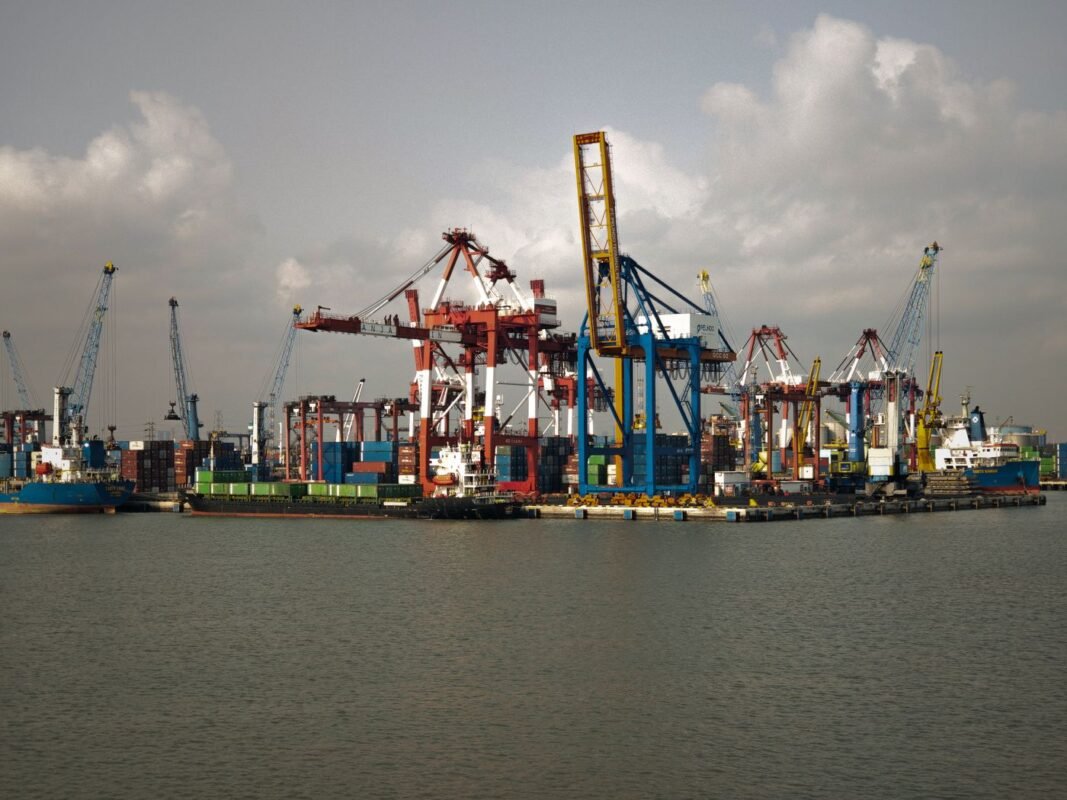
When the feeder arrives, it usually waits at the outer anchorage until CPA allocates a berth. Berths are assigned through the port’s berthing schedule, which balances vessel arrival order, priority categories, tide windows and available jetties. Container vessels are handled at the dedicated container terminals — Chittagong Container Terminal (CCT), New Mooring Container Terminal (NCT) and the newer Patenga Container Terminal — and at some general cargo berths. During congestion, waiting time at anchorage can stretch, which is why the “ETA Chattogram” on a schedule and the actual discharge date can differ noticeably. See our piece on Chattogram congestion for how this plays out.
Stage 3: Discharge, yard stacking and the off-dock split
Once alongside, quay cranes lift containers off the ship and terminal equipment moves them to the yard. From here, containers follow different paths depending on their type:
- FCL containers for port delivery are stacked in the port yard and wait there for customs release and delivery.
- LCL and certain categories of cargo are moved to private off-dock depots (ICDs) around Chattogram, where they are unstuffed and cleared. Our off-dock depot guide explains this arrangement.
- Containers booked for the Kamalapur ICD in Dhaka are positioned for rail movement and cleared at the inland depot instead. See the ICD process.
- Reefer containers are plugged into the reefer yard power points, where temperature monitoring continues.
The moment of discharge (often called the landing date) matters because it usually starts the port’s free storage period. After free time ends, CPA storage rent begins to accrue on the container, independently of any shipping line charges. The shipping line’s own free time for the equipment runs on a separate clock. Our free time explainer and demurrage and detention guide separate the two.
Stage 4: Customs assessment runs in parallel
While the container sits in the yard, the C&F agent works the paperwork track: lodging or finalising the Bill of Entry, responding to assessment queries, and arranging duty and tax payment. If customs selects the consignment for examination, the physical track gets involved again: the container has to be shifted to an examination area, opened, inspected in the presence of the agent, and closed again with a new seal. Some containers are also routed through non-intrusive scanning. Each of these moves involves port equipment and therefore port handling charges, and each one depends on yard capacity at that moment.
This is where a clean declaration earns its keep. A consignment whose invoice, packing list and bill of lading all agree, with correct HS codes, is less likely to be pulled into extended examination. See what customs checks during clearance for the triggers.
Stage 5: Delivery order, port bills and the gate pass
Customs release on its own does not get the container out. Three more things must happen:
- Delivery order from the shipping line. The line’s local agent issues a delivery order once local charges are paid and the original bill of lading is surrendered, or a telex release or sea waybill is in place. If originals are stuck with a bank under an LC, everything waits — see when originals are delayed.
- Port charges paid to CPA. These include landing and handling charges and any storage rent that has accrued. The agent pays these against the port bill.
- Gate pass. With customs release, the delivery order and port charges settled, the port issues the documentation that allows the container or cargo to leave.
Our guide to the delivery order explains the shipping-line side of this step.
Stage 6: Gate-out and the inland leg
At the gate, security checks the container number and seal against the release documents. The container then leaves on a prime mover, or the cargo is unstuffed and loaded into covered vans, depending on how delivery was arranged. If you are moving a full container inland, the empty must be returned to the shipping line’s designated depot within its free time, otherwise detention accrues. The options for the onward trip — road, rail or river — are compared in our Chattogram to Dhaka haulage guide.
Where shipments actually lose days at Chattogram
From experience handling China cargo through this port, delays cluster in a few predictable places:
- Manifest mismatches that block Bill of Entry lodgement until amended.
- Late original documents, especially under LC, which hold the delivery order.
- Unpaid or disputed local charges at the shipping line, which hold the delivery order even after customs release.
- Examination queues when yard space and equipment are stretched.
- Funding gaps where the duty amount is known but money is not ready, so the box waits while rent accrues.
- Truck availability around holidays, Eid and hartal periods, which leaves a released container sitting.
None of these are about the port being slow in the abstract. Each is a specific hand-off where one party is waiting for another. Planning the hand-offs in advance is how you shorten the timeline.
What the importer should have ready
Before the vessel even reaches the outer anchorage, a well-prepared importer has: the final bill of lading checked against the invoice and packing list; an IRC, BIN and any product-specific permits in place; the C&F agent appointed with a valid authorisation; funds earmarked for duty, VAT, AIT and port charges; and a transport plan for the day of release. With those in hand, the port process becomes a sequence of predictable steps rather than a string of surprises.
Every shipment is different, so we do not publish fixed rates or timelines for Chattogram port clearance. Tell us your product, volume and destination and ask us for a quote built around your needs. You can also see our full sourcing, freight and C&F services, use our China sourcing and buying agent service, or browse products we already source.
