
Food Ingredients, Import & Export Guides
How to Store Food Ingredient Powders in Bangladesh Humidity: Stop Caking and Spoilage
Oct
To keep imported food ingredient powders from caking or spoiling in Bangladesh’s humidity, keep them sealed in their original lined bags until the day of use, store them on pallets in a dry, cool room away from walls and the floor, reseal opened bags immediately, and use the oldest lot first according to the manufacturing date on the COA. Powders such as HVP, soy sauce powder, seasoning blends and spray-dried flavours absorb water from the air, and once they lump the damage is hard to undo. DE International delivers small ingredient orders from China door-to-door, and its sister company Shenzhen Phoenix Rising Technology handles LC orders and factory checks — both can help you ask for packaging that survives the trip and the monsoon.
Why do some ingredient powders cake in Bangladesh?
Many food ingredients are hygroscopic: they pull water vapour out of the surrounding air. Every hygroscopic powder has a point, often called its critical relative humidity, above which it starts absorbing moisture faster than it can release it. Below that point the powder stays free-flowing; above it, the surface of each particle turns slightly sticky, particles bridge together, and when the humidity drops again those bridges dry into hard lumps. That cycle is caking.
Dhaka and Chattogram spend much of the year, especially the monsoon, above the humidity many dry powders tolerate, and a store room without air conditioning follows the outside air closely. Salt, sugars and hydrolysed proteins are among the most moisture-hungry components, which is why seasoning blends and HVP are usually the first items to lump.
Moisture does more than make lumps. Wet powder disperses unevenly in a mixer, so a seasoning line gets salty and bland patches. Higher water activity can also let moulds grow, turning a handling problem into a food safety one.
Which ingredients are most at risk, and what should you ask for?
Risk depends on the form of the ingredient as much as its chemistry. The supplier’s own data sheet always takes priority.
| Ingredient | Usual form | Main storage risk | What to ask the supplier |
|---|---|---|---|
| HVP (hydrolysed vegetable protein) | Powder or paste | Absorbs moisture quickly, lumps, darkens over time | Lined bags with a sealed inner PE bag; recommended storage conditions and shelf life in writing |
| Soy sauce powder | Spray-dried powder | Caking, loss of free-flow in dosing equipment | Moisture specification on the COA; option of an anti-caking agent if your recipe allows |
| Seasoning blends and flavour enhancers | Powder or granules | Salt and sugar content pull in water; uneven dosing | Pack size matched to your daily use so bags are not left half open |
| Spray-dried flavours | Powder | Aroma loss through moisture and heat | Aluminium foil laminated bags or sealed tins for small packs |
| Caramel colour | Liquid or powder | Powder lumps; liquid is sensitive to heat over time | Drum or IBC for liquid; ask how warm storage affects shelf life |
| Yeast and sodium bicarbonate | Granules or powder | Yeast loses activity in heat and moisture; bicarbonate can cake | Vacuum or sealed packs for yeast; clear best-before dates |
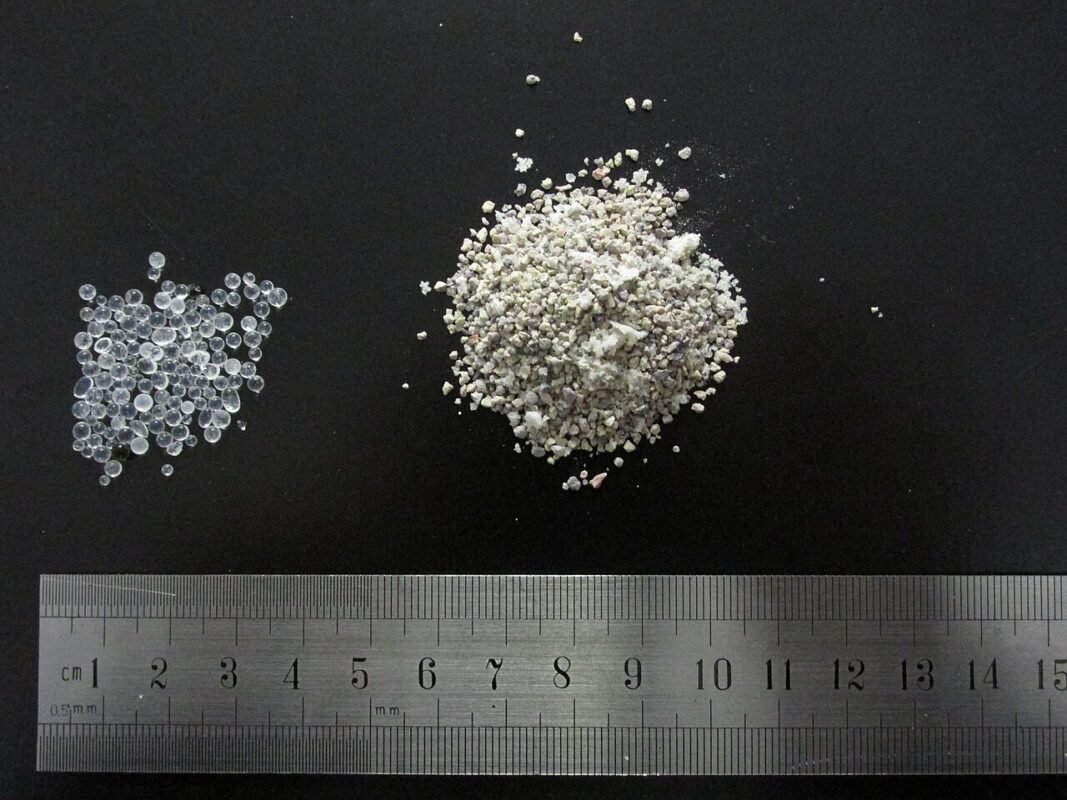
Photo: silica gel (left) and clay desiccant (right). Jeran Renz, CC BY-SA 4.0, via Wikimedia Commons.
What packaging protects powders on the way from China?
Most dry ingredients travel in multi-ply kraft paper bags or fibre drums with an inner polyethylene bag. The paper gives strength; the inner PE bag is the actual moisture barrier. That is why the first thing to check on arrival is not the outer bag but whether the inner liner is intact and tied or heat-sealed. A torn paper bag with an unbroken liner is usually fine; a clean paper bag with a slit liner is not.
For flavours, ask for aluminium foil laminated inner bags, which block water vapour far better than plain PE, and insist that samples arrive sealed, never folded and taped.
Sea shipments add a hidden risk called container rain. Air inside a closed container warms during the day and cools at night; moisture condenses on the steel roof and drips onto the top layer of bags. Shippers reduce it with container desiccant bags hung along the walls, dry pallets, and no wet wood in the load. When you consolidate several ingredients into one box, as described in our guide to combining food ingredients in one shipment, ask for powders to sit on the lower tiers, away from the roof and doors.
How should you receive an ingredient lot at the factory?
- Check the documents first. Match the lot number on each bag to the lot number on the COA and the packing list. A COA that covers a different lot tells you nothing about what is in front of you.
- Inspect the outside. Look for water stains, crushed corners and bags from the top tier that feel damp.
- Open one bag per lot in a clean area. The powder should pour freely or break apart with light pressure. Hard lumps that do not crumble are a warning sign.
- Retain a sample. Keep a small sealed sample from each lot, labelled with lot number and receiving date, so you can compare later batches or answer a complaint.
- Record the dates. Write the manufacturing date and best-before date on your stock card, not just the arrival date.
If the powder is lumpy on arrival, test it before use, as explained in our guide to testing a food ingredient sample. Some soft caking breaks up with sieving and still meets specification; hard caking or any off smell should go back to QC and the supplier.
How do you set up the store room?
You do not need a full climate-controlled warehouse, but you do need to stop the bags breathing outside air:
- Pallets, not the floor. Concrete floors wick moisture upward. Keep them a hand’s width from walls.
- Doors closed, windows closed. An ingredient store should not double as a passage to the loading bay. Every open door during the monsoon lets in humid air.
- A separate dry room for sensitive powders. A small sealed room with an air conditioner or a dehumidifier protects HVP, seasonings and flavours far better than the general store. Hang a hygrometer so staff can see the humidity, not guess it.
- Away from heat. Do not stack ingredients against a sun-facing wall, under a tin roof or near ovens and fryers.
Use FEFO (first expired, first out) rather than simply first in, first out. Two lots can arrive in the same month with very different manufacturing dates, and the older one should be used first.
What happens once a bag is opened?
Most caking starts after a bag is opened. Two habits help, plus buying pack sizes your line finishes within a few days of opening:
- Reseal the inner liner after every use with a hand impulse sealer or a strong clip, then close the outer bag.
- Weigh out only what the next shift needs into a clean, lidded container, and return the main bag to the dry room.
Common mistakes and what they cost
- Ordering a full year of a hygroscopic powder in one lot to save on freight. The last bags sit through a monsoon and arrive at the mixer as lumps. Ask how to split a yearly volume into several smaller shipments instead.
- Storing powders next to the boiler or fryer because the space is free. Heat and humidity together shorten shelf life faster than either alone.
How DE International and Phoenix Rising can help
Our partner factories in China are FSSC 22000, ISO 22000 or HACCP (or ISO 9001) certified, with Halal (including MUI) and Kosher products available, and we arrange samples and a COA before you order. Tell us how you store ingredients and how fast you use them, and we will ask for pack sizes and liners that suit a humid store. Storage life depends on the exact product and your conditions, so ask us for the manufacturer’s written storage advice.
DE International ships small quantities door-to-door to Dhaka and Chattogram, while Shenzhen Phoenix Rising Technology handles LC orders and factory checks for larger volumes. See the full range on the Phoenix Rising food ingredients page.
FAQ
How do I stop seasoning powder from caking in Bangladesh?
Keep it sealed in its lined bag until use, store it on pallets in a dry, air-conditioned or dehumidified room, reseal opened bags at once, and buy pack sizes you finish within a few days of opening.
Can I still use HVP or soy sauce powder that has formed lumps?
Soft lumps that break apart easily may still meet specification after sieving, but test it first. Hard lumps, colour change or an off smell should go to QC and the supplier before use.
What packaging should I ask a Chinese supplier to use for food powders?
Ask for multi-ply bags or drums with a sealed inner polyethylene liner, aluminium foil inner bags for flavours, and sealed sample packs. Confirm storage conditions and shelf life in writing.
Who can supply food ingredients from China to a Bangladeshi factory with samples and COA?
DE International delivers small quantities door-to-door, and Shenzhen Phoenix Rising Technology handles LC orders and factory checks. WhatsApp +880 1750-859967.
For a quote built around your ingredients and storage conditions, see our services, the China sourcing and buying agent service and our shop, or contact us — WhatsApp +880 1750-859967. Related reading: importing food additives: documents and COA and HVP in chanachur, chips and noodles.
