
Import & Export Guides
Water Bottle Making Machine Price in Bangladesh: What a Small PET Bottle Unit Needs
Nov
A water bottle making machine in Bangladesh is usually a PET stretch blow moulding machine: it heats ready-made PET preforms and blows them into bottles inside a mould. A small bottled water unit typically needs the blow moulder plus a high-pressure air compressor, an air dryer and filters, a chiller and one mould per bottle design — and, separately, the water treatment and filling line. The water bottle making machine price in Bangladesh therefore depends on whether you choose a semi-automatic or automatic machine, how many cavities it has, how many moulds you need and the support equipment; DE International sources these machines from plastic machinery factories in China and delivers them door-to-door, so ask us for a quote built around your bottle sizes and daily target.
How is a PET water bottle actually made?
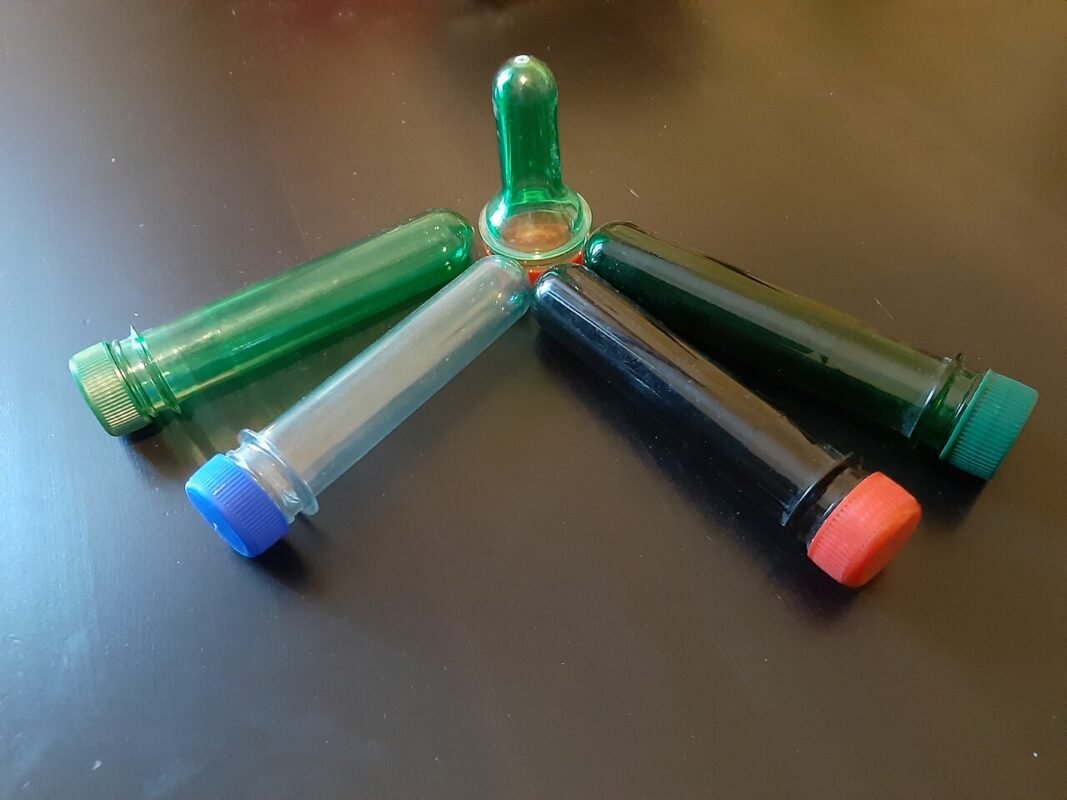
Almost every water and soft drink bottle sold in Dhaka, Chattogram or Sylhet is made in two steps. First, PET resin is injection moulded into a preform — a thick test-tube shape whose screw neck is already finished. Second, the preform is reheated and stretch blow moulded: a rod stretches it lengthwise while compressed air blows it outward against a cold mould, which gives the bottle its shape, wall thickness and strength.
The important point for a new business is that the neck never changes during blowing. If your cap supplier uses a particular neck finish, the preform must have that finish. Common names you will hear from Chinese factories are PCO 1810 and PCO 1881 for water and carbonated drinks, and smaller necks for some water bottles. Choosing the neck first saves you from buying preforms and caps that do not fit each other.
Most small Bangladeshi water plants buy preforms locally or import them and only run the blowing step. Making preforms needs an injection moulding machine, a preform mould and a resin dryer — see injection molding machine prices in Bangladesh.
Which machines does a small PET bottle unit need?
A blow moulding machine does not work on its own. When you compare offers from China, check that each item below is either included or quoted separately, because missing items are where budgets go wrong.
| Equipment | What it does | What to check before buying |
|---|---|---|
| Stretch blow moulding machine | Heats preforms and blows them into bottles | Semi-automatic or automatic, number of cavities, bottle volume range |
| Preform heater or loader | Infrared oven that softens preforms evenly (built in on automatic machines) | Whether it can handle your preform weight and neck size |
| High-pressure air compressor | Supplies the blowing air, which is far above normal workshop pressure | Air volume matched to the blow moulder, not a general compressor |
| Air dryer and filters | Removes moisture and oil from the blowing air | Oil or water in the air marks bottles and is a hygiene risk |
| Water chiller | Cools the mould so bottles set quickly | Cooling capacity suited to the machine; Bangladeshi summer heat matters |
| Moulds | One mould per bottle shape and size | Bottle drawing approved before cutting; ask what a second mould costs |
| Voltage stabiliser | Protects heaters and controls from voltage swings | Rated for the full connected load |
After the bottles are blown, a water business also needs water treatment (sand and carbon filters, RO, UV or ozone), a rinsing-filling-capping machine, a labelling or shrink sleeve machine and carton packing. Those are covered in how to start a bottled water business in Bangladesh and liquid and beverage filling machines.
Semi-automatic or automatic blow moulding machine?
A semi-automatic machine has a separate infrared heater, and an operator loads heated preforms and removes bottles. An automatic machine has a preform hopper, inline oven and automatic discharge, often onto an air conveyor feeding the filler.
| Point | Semi-automatic | Automatic (linear or rotary) |
|---|---|---|
| Investment | Lower | Higher, rises with cavities |
| Labour | One or more operators per machine, all shift | Mainly monitoring and loading preforms |
| Bottle consistency | Depends on operator skill and heating time | More even because heating and timing are controlled |
| Hygiene | Hands touch preforms and bottles | Less handling, easier to keep clean |
| Best for | Starting out, many sizes, small daily output | Steady demand for one or two sizes |
A useful rule: if you will sell mostly one size, automatic usually pays back through lower labour and fewer rejects; if you are testing several sizes at modest volume, semi-automatic keeps capital free for distribution, where most new water brands struggle.
What decides the water bottle making machine price?
We do not publish fixed prices, because two machines with the same name can be very different. The price you are quoted is decided by these factors:
- Cavities. A two-cavity machine blows two bottles per cycle; four or six cavities multiply output and price.
- Bottle volume range. Machines for small bottles differ from those that blow large jars; one machine rarely does everything well.
- Automation level. Semi-automatic, linear automatic or rotary high-speed.
- Number of moulds. Each extra bottle design or size is another mould.
- Support equipment. Compressors, dryer, filters and chiller can add a large share to the total if they are not in the first quote.
- Component brands. PLC, touchscreen, valves and heaters from well-known brands cost more but are easier to repair in Bangladesh.
- Freight and clearance. Machine size, crate volume, the port (Chattogram or Benapole) and delivery to your site.
Send us your bottle sizes, neck finish, target bottles per hour and site electricity, and we will compare offers from several Chinese factories as a landed cost.
Bottle design, weight and moulds: decide before you order
The mould is the part most buyers rush. A factory will cut a mould from a bottle drawing, so agree the drawing in writing: volume to the brim, height, diameter, base shape (petaloid bases are for carbonated drinks; flat or champagne bases are common for still water), label panel height and the preform weight. A lighter preform saves resin on every bottle, but too light a bottle collapses when a customer squeezes it or stacks cartons in a hot godown.
Ask the factory to blow samples with your preforms and courier them before the machine ships. Check the cap seals, the label fits and the bottle stands straight; fixing a mould after it reaches Bangladesh means returning it or paying for a new one.
Electricity, space and the Bangladesh site
Blow moulding is electricity-hungry. The infrared heaters and the high-pressure compressor are the largest loads, and the chiller runs all day in summer. Before ordering, get the total connected load from the factory in writing and confirm with your electricity provider or an electrician that your connection can carry it. Many factory owners outside Dhaka also plan for a generator, because a power cut mid-cycle leaves half-heated preforms that must be scrapped.
Keep the compressor room separate and ventilated, away from the clean bottling area, and store preforms dust-free and dry, since both dust and moisture show up as marked bottles. Confirm 220/380 V, 50 Hz on the proforma invoice.
Importing the machine and the BSTI side of a water business
Blow moulding machines are generally classified under HS heading 8477 (machinery for working plastics). The exact sub-code, duty and any concession for capital machinery should be confirmed with your C&F agent at the time of import, because rates change with each budget. Customs will want a commercial invoice, packing list, bill of lading and the machine specification; a clear technical description helps avoid a mis-classification query at Chattogram. Our guide to essential import documents explains each paper.
The machine itself is only half the licensing picture. Packaged drinking water is on the BSTI mandatory certification list, so your water, bottles and labelling must pass BSTI requirements before you sell. Check the current BSTI and BFSA requirements before you design the factory layout; see BSTI certification explained.
Common mistakes when buying a bottle blowing machine
- Buying the blower without the right compressor. A general workshop compressor cannot reach blowing pressure, so the machine sits idle until the correct one arrives.
- Ignoring air quality. Skipping the dryer and filters leads to oily or wet air inside bottles meant for drinking water.
- Choosing a neck finish the local cap supplier does not make. You end up importing caps for every order.
- No spare parts. Ask for a list of wearing parts (seals, heater lamps, valves) and ship a set with the machine.
FAQ
What is the price of a water bottle making machine in Bangladesh?
It depends on semi-automatic versus automatic, number of cavities, the number of moulds and whether the compressor, dryer and chiller are included, plus freight. Send DE International your bottle sizes and target output and we will quote a landed price.
Can I start a water bottle business without making preforms?
Yes. Most small units buy preforms and only blow bottles; making preforms is a separate, larger investment.
Do I need BSTI approval for bottled water in Bangladesh?
Yes, packaged drinking water is a BSTI mandatory product; confirm the current process before construction.
Who can import a PET bottle blowing machine from China to Bangladesh?
DE International sources blow moulding machines from Chinese factories, checks sample bottles with your preforms, inspects before shipping and delivers door-to-door. WhatsApp us on +880 1750-859967.
Next steps: browse our services, the China sourcing and buying agent service and our machinery shop. For the cost of shipping a machine to Chattogram or Dhaka, get a cargo quote at decl.bd, or contact us — WhatsApp +880 1750-859967.
