
Import & Export Guides
Sticker Printing Machine Price in Bangladesh: Which Printer and Cutter Suit a Small Print Shop
Nov
For a small print shop in Bangladesh, the right sticker printing machine is usually not one machine but a pair: a printer that puts the colour on self-adhesive vinyl or paper, and a cutting plotter that cuts each sticker to shape. A shop that mainly makes single-colour vehicle and shop-glass lettering can start with a vinyl cutting plotter alone; a shop that makes full-colour bike, laptop and promotional stickers needs an eco-solvent printer plus a contour-cutting plotter with an optical eye, and a laminator. The sticker printing machine price in Bangladesh depends on print width, printhead type, cutting force, whether the cutter reads registration marks, and the software and finishing units you add — DE International sources these machines from manufacturers in Guangzhou and Shenzhen and delivers them door-to-door, so ask us for a quote built around the stickers you actually plan to sell.
Which kind of sticker do you want to sell?
Start from the product, not the machine. Sticker work in Dhaka, Chattogram and district towns falls into a few clear groups, and each group points to a different setup:
- Cut-vinyl lettering — names on shop glass, office door signs, number and name decals on bikes and CNGs, wall lettering. Made from solid-colour vinyl with no printing at all.
- Full-colour die-cut stickers — bike and car graphics, laptop stickers, political and event stickers, brand giveaways. Printed first, then contour cut around the design.
- Sheet stickers — A4 or A3 sheets of small product stickers for home bakers, cosmetics sellers and Facebook shops, often kiss-cut so the customer peels them off one by one.
- Roll product labels — labels for spice packets, honey jars and juice bottles that go onto a labelling machine. This is a label press job, covered separately in our guide to label printing machine prices in Bangladesh.
Decide which of these you will sell in the first six months before asking any supplier for an offer; it changes the width, the cutter and the budget.
What machines does a sticker printing shop need?
| Machine | What it does | What to check |
|---|---|---|
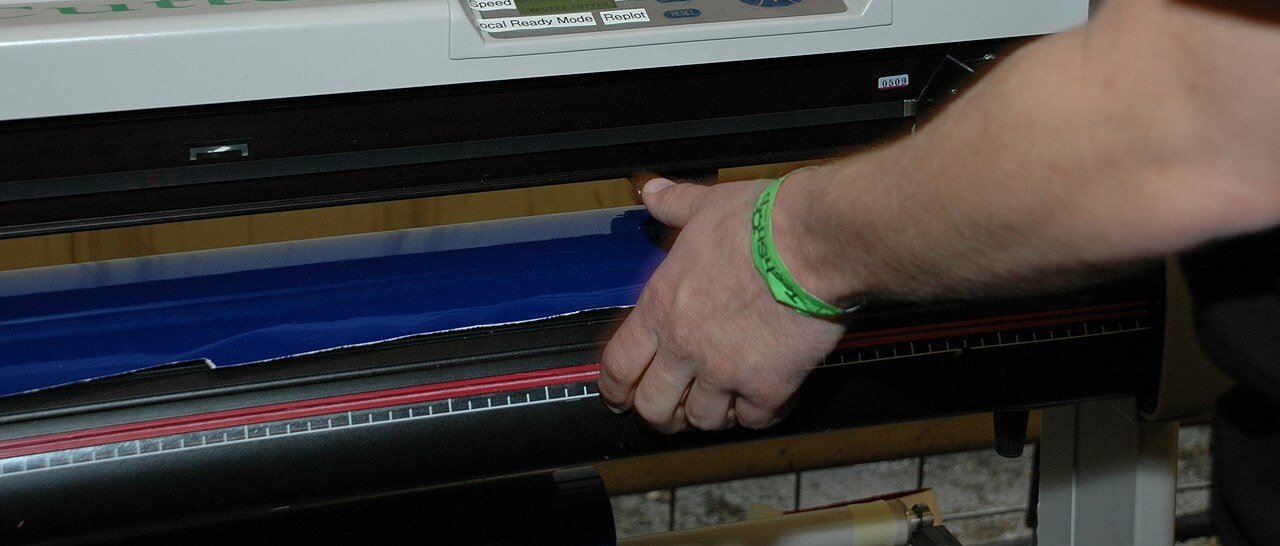
| Vinyl cutting plotter | Cuts through the vinyl film with a small drag knife, leaving the backing paper uncut | Cutting width, cutting force, servo or stepper motor, whether it has an optical eye |
| Eco-solvent large format printer | Prints full colour onto self-adhesive vinyl, one-way film and banner media | Print width, printhead model and count, RIP software, ink system, heater and dryer |
| Contour cutter with optical eye | Reads printed registration marks and cuts around each printed design | Mark-reading accuracy over a long roll, software that works with your printer |
| Cold laminator | Applies a clear protective film over printed stickers | Width matched to the printer, pressure adjustment, glossy and matte film |
| Sheet sticker cutter (A3 or A4) | Kiss-cuts or die-cuts sheets printed on a laser or inkjet printer | Sheet feeder, mark reading, the sticker paper it is tested with |
Two items are easy to forget on a quotation from China: the RIP software that turns your CorelDRAW or Illustrator file into printer instructions and manages colour, and the cutting software that sends cut paths to the plotter. Ask which software is included, whether it is licensed, and whether it runs on your shop’s Windows version.
How does print-and-cut actually work?
Full-colour die-cut stickers are made by print-and-cut, and the steps explain most buying decisions:
- Design with a cut line. The designer draws the artwork and a separate contour line around each sticker, usually as a named spot-colour path in CorelDRAW or Illustrator.
- Print with registration marks. The RIP software prints the artwork on vinyl and adds small black marks at the corners of the job.
- Dry, then laminate. Eco-solvent ink needs time for the solvent to leave the vinyl; laminating too soon traps it and the film can bubble or lift later. Outdoor stickers in Bangladesh almost always need lamination.
- Load into the cutter. The optical eye finds the registration marks and corrects for any skew or stretch in the vinyl.
- Contour cut and weed. The plotter cuts the contour line; an operator removes the waste vinyl around each sticker.
The weak point is step 4. Vinyl moves slightly during printing, heating and lamination, so a cutter that reads only the first marks can drift on a long job and miss the printed edge. Cutters that read marks along the length of the job hold their accuracy better. When you compare machines, ask the supplier for a video of their cutter contour cutting a long printed job, not just a single short sheet.
Eco-solvent, UV or a normal inkjet printer?
| Point | Eco-solvent printer | UV printer | Desktop inkjet or laser |
|---|---|---|---|
| Typical use | Vehicle stickers, shop graphics, outdoor vinyl | Premium stickers, UV DTF, printing on rigid items | Small indoor sheet stickers |
| Outdoor life | Good on vinyl, better with lamination | Good, depends on ink and substrate | Short unless laminated and using suitable stock |
| Drying | Needs heater and drying time before lamination | Cures instantly under UV lamps | Dry quickly |
| Investment | Moderate, rises with width and heads | Higher | Lowest |
Many Chinese eco-solvent printers use printheads made by a few Japanese manufacturers, and the head model matters more than the printer brand: it decides speed, print quality, and how easy it is to buy a replacement head in Bangladesh later. Ask for the exact head model in writing, and ask how many heads the machine has, because a two-head machine is faster but costs more to maintain.
What decides the sticker printing machine price?
Two machines with the same name on a supplier page can be very different underneath, so we do not publish a fixed price. These factors move the quotation:
- Width — a desktop cutter, a mid-width plotter and a full-width roll machine are priced very differently, and wider vinyl rolls cost more too.
- Motor type — servo-motor cutters are quieter and hold accuracy at speed; stepper-motor cutters are simpler and cheaper.
- Optical eye — a cutter without mark reading can only do lettering and simple shapes; adding contour cutting raises the price.
- Printhead model and count — the biggest single driver on the printer side.
- Software and accessories — RIP and cutting software, take-up roller, spare blades.
- Freight and duty — added on top of the factory price; our breakdown of hidden charges when importing from China lists what to budget for.
Send us your sticker sizes, monthly volume and whether you need outdoor durability, and we will get factories to quote a matching setup.
Running a sticker shop in Bangladeshi conditions
Machines that run well in an air-conditioned showroom in Guangzhou can struggle in a humid shop in Dhaka. Plan for these:
- Humidity and dust — damp media curls and feeds badly, and dust shows as specks. Store media sealed.
- Idle printheads — heads can clog when a printer stands idle for days, for example over Eid; run a daily nozzle check and follow the maker’s storage steps before long breaks.
- Voltage swings and load-shedding — a cut mid-print wastes media. Use a voltage stabiliser and a UPS for the printer controls, and confirm the machine is built for 220V 50Hz.
- Ventilation — eco-solvent ink still has a solvent smell; do not run it in a sealed small room where staff sit all day.
- Consumables — confirm ink, blades and spare heads for your exact model can be imported later, or bring a spare set with the machine.
Importing the machines from China step by step
- Shortlist. Ask two or three factories to quote the same specification.
- Ask for a test print. Send your own design with a contour line and ask the factory to print and cut it on video.
- Check the supplier. Confirm the company is real and is the actual seller; our guide on verifying a Chinese supplier before paying covers the checks.
- Fix the details in the proforma invoice — head model, included software, spare parts, voltage, warranty terms and training.
- Inspect before shipping. A pre-shipment check confirms the machine powers up, prints and cuts, and is packed in a wooden crate fit for sea freight.
- Clear customs with the right description. Printers and cutting plotters can fall under different HS codes, so confirm classification with your C&F agent; see understanding HS codes for Bangladesh imports.
DE International can handle all of these steps and deliver to your shop in Bangladesh.
FAQ
Which sticker printing machine is best for a small print shop in Bangladesh?
For cut lettering only, a vinyl cutting plotter is enough. For full-colour die-cut stickers, an eco-solvent printer with a contour-cutting plotter that reads registration marks, plus a cold laminator, is the usual starting setup.
Can I make stickers with a normal printer and a cutting machine?
Yes for indoor sheet stickers: a good inkjet or laser printer on suitable sticker paper and an A3 or A4 sheet cutter with mark reading works well. For outdoor vehicle stickers you need solvent-resistant ink on vinyl, and lamination.
What does a sticker printing machine cost in Bangladesh?
It depends on width, printhead, cutter type, software and freight. Ask us for a current quote built around your sticker sizes and monthly volume.
Who can import a sticker printing and cutting machine from China to Bangladesh?
DE International sources printers, cutting plotters and laminators from Chinese manufacturers, checks them before shipping and delivers door-to-door in Bangladesh. WhatsApp +880 1750-859967.
Next steps: see our services, the China sourcing and buying agent service, related machines such as the heat press and DTF printer, browse the shop, or contact us for a quote. For shipping costs, use the decl.bd quote form.
