
Import & Export Guides
Heat Press Machine Price in Bangladesh: Which Press Suits a T-Shirt, Mug or DTF Business
Nov
The heat press that suits your business depends on what you press: a flat clamshell or swing-away press for t-shirts and DTF transfers, a mug press for sublimation mugs, and a combo press only if you are testing several products in small numbers. The heat press machine price in Bangladesh is decided by platen size, the opening style, manual or pneumatic operation, how evenly the platen heats, and the freight and duty added to the factory price. DE International sources heat press machines from factories in China and delivers them door-to-door to Dhaka, Narayanganj, Gazipur or Chattogram — ask us for a quote based on the products you plan to print.
What a heat press does, and what it does not do
A heat press does not print anything. It applies three controlled things — temperature, pressure and time — to bond a ready-made transfer to a product. The image itself comes from somewhere else: a sublimation printer, a DTF printer, a vinyl cutter, or screen-printed transfer sheets bought from a supplier. So the first business question is not which heat press, but which transfer method, because that decides what else you must buy and what products you can sell.
| Transfer method | What makes the image | Works on | Typical products in Bangladesh |
|---|---|---|---|
| Sublimation | Sublimation printer, ink and paper | White or light polyester fabric and specially coated hard blanks; not plain cotton | Football and cricket jerseys, mugs, plates, mouse pads, photo frames |
| DTF (direct to film) | DTF printer with powder shaker, or films bought ready-printed | Cotton, polyester and blends, light or dark | Brand t-shirts, hoodies, tote bags, small custom orders |
| Heat transfer vinyl | Vinyl cutter (plotter) | Most fabrics | Names and numbers on jerseys, single-colour logos |
| Screen-printed transfers | Printed in bulk by a screen printer onto release paper | Most fabrics | Neck labels, repeat logos for garment orders |
If DTF is your plan, read our guide to the DTF printing machine price in Bangladesh first; the heat press is the smaller part of that investment. For direct printing in volume, compare with an automatic screen printing machine.
Which type of heat press fits a t-shirt, mug or DTF business
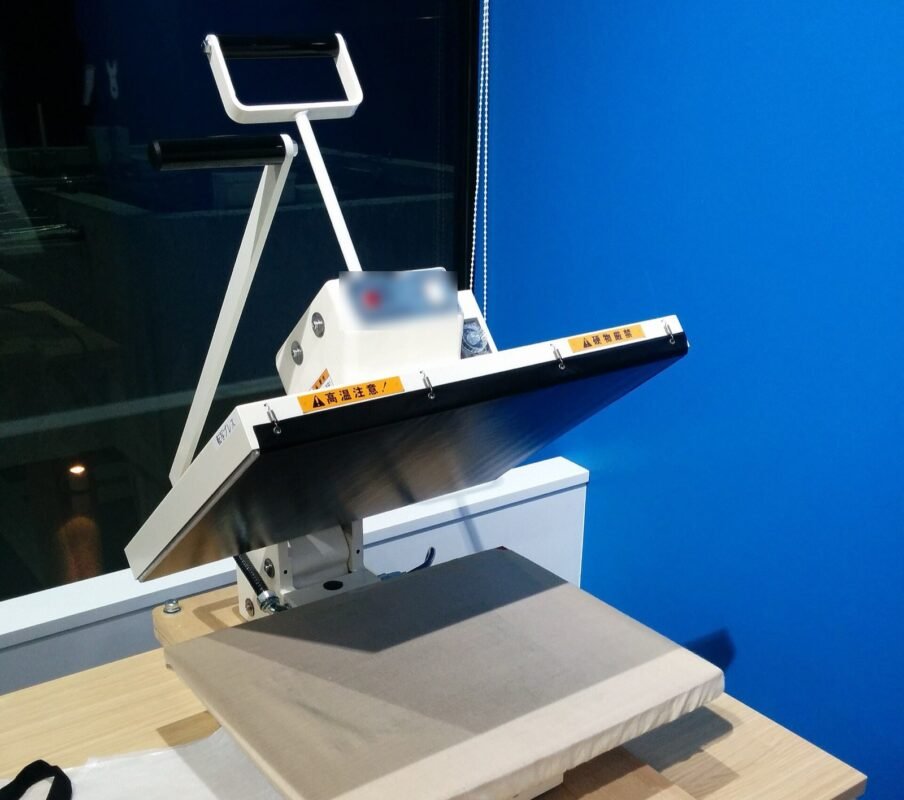
- Clamshell press. The top platen hinges up like a mouth, as in the photo above. It takes the least table space and is quick to operate, which suits a small shop pressing t-shirts all day. The hot platen stays above your hands, so placing transfers needs care, and thick items get more pressure at the hinge side than at the front.
- Swing-away press. The top platen lifts and swings to the side, leaving the lower platen fully open. It presses straight down, so pressure is more even on thick items such as hoodies, tiles and plaques, but it needs clear space beside the machine.
- Draw (slide-out) press. The lower platen pulls out towards you like a drawer, so you lay out the garment away from the heat. A good middle path for a narrow shop.
- Mug press. A curved heating blanket wraps around a coated mug. Different mug sizes and shapes need different heating attachments; cone-shaped mugs and tumblers need their own.
- Combo press (5-in-1, 8-in-1). One body with interchangeable t-shirt, mug, plate and cap attachments. Useful for sampling and gift shops with mixed small orders; slow for volume because every product change means swapping and reheating an attachment.
- Pneumatic and double-station presses. An air cylinder closes the platen at the same pressure every time, and a shuttle with two lower platens lets the operator load one side while the other is pressing. These suit garment factories and busy DTF shops, and they need an air compressor.
What decides the price of a heat press machine
We do not list fixed prices because the same-looking press can be built with very different heating plates and controls, and freight, duty and VAT sit on top of the factory price. Use this table to compare quotations:
| Price factor | What to ask the supplier |
|---|---|
| Platen size | Common flat sizes are around 38 x 38 cm and 40 x 60 cm. Will your largest design and garment size fit with margin? |
| Opening style | Clamshell, swing-away or draw? Does the upper platen float to stay parallel on thick items? |
| Operation | Manual lever, auto-open with magnet, or pneumatic? Is the compressor included? |
| Heating plate | How thick is the aluminium platen and how are the heating elements laid out? This decides how evenly it heats. |
| Attachments | For combo and mug presses, exactly which attachments and mug sizes are in the box? |
| Electrical supply | Voltage, wattage and plug type for Bangladesh, and the cable size the machine needs. |
Even heat and even pressure: the quality check that matters most
Almost every complaint a print shop gets — edges of a transfer peeling after two washes, a faded patch in a sublimation print, a shiny rectangle scorched into the fabric — traces back to heat or pressure that was not what the display claimed. A platen with widely spaced heating elements has cold zones between them and at the corners. The controller reads one sensor, usually near the centre, so the screen can show the right number while the corners run cooler.
You can check this on any sample machine or on the day your order arrives:
- Heat the press to your normal working temperature and let it sit for several minutes so the plate stabilises.
- Measure the platen surface at the centre, the four corners and the middle of each edge with a contact thermometer or temperature test strips. An infrared gun is less reliable on shiny coated metal.
- Compare the readings with each other and with the display. A good plate stays close across the whole surface; a poor one drops clearly towards the corners.
- Close the press on four strips of paper, one at each corner, and try to pull each one out. If one slides freely, pressure is uneven and the platen needs adjusting or is warped.
- Press one real transfer on your own fabric, wash it, and look at the edges.
When DE International inspects heat presses in China before shipment, this corner-to-centre temperature check is part of what we report back, with photos.
Electricity, workspace and consumables in a Bangladeshi shop
- Power. Desktop presses run on ordinary single-phase supply, but a large platen draws a heavy current while heating. Give it its own properly rated socket and cable rather than a shared multi-plug, and confirm the wattage with the supplier. Where voltage drops in the evening, heating takes longer and the temperature swings; a voltage stabiliser sized for the machine helps.
- Heat and ventilation. A press running all day warms a small room quickly, and sublimation and DTF give off fumes. Plan a fan and an exhaust, not only an air-conditioner.
- Consumables. Teflon or parchment cover sheets, heat-resistant tape, pressing pillows for seams, zips and buttons, and spare silicone pads. For sublimation add paper, ink and coated blanks; mugs must have a sublimation coating or the image will wash off.
- Settings. Each transfer film, vinyl and paper comes with its own recommended temperature, time and pressure. Follow the sheet from your transfer supplier and test on your fabric, rather than copying numbers from another shop.
Importing a heat press from China: how the order usually runs
- Tell us what you will press (t-shirts, jerseys, mugs, caps), the largest design size and how many pieces a day you expect.
- We collect quotations from factories for the matching press type and confirm voltage, plug, attachments and spare parts in writing.
- For larger orders we inspect the machines before shipment, including the heat and pressure checks above.
- Single desktop presses and mug presses can move by air cargo; several machines or pneumatic and large-format presses are better consolidated by sea. Get a freight estimate from the decl.bd quote form.
- Duty and VAT depend on the HS code the press is declared under, so we ask the C&F agent for a current calculation for your shipment instead of quoting an old rate.
- Delivery to your shop, with the factory manual and controller settings.
Many buyers add a computer embroidery machine to the same shipment to offer both print and embroidery. For choosing between decoration methods on imported goods, see logo and brand printing methods.
Common mistakes when buying a heat press
- Buying a combo press for volume work. Attachment changes eat the day; a dedicated flat press and a separate mug press are faster.
- Choosing a platen that is too small. Large back prints then need two presses with a visible overlap line.
- Expecting sublimation to work on cotton. The dye bonds with polyester; on cotton it washes out. Use DTF or vinyl for cotton.
FAQ
What is the heat press machine price in Bangladesh?
It depends on platen size, clamshell, swing-away or pneumatic design, heating plate quality, attachments, freight and duty. Tell DE International what you plan to press and we will quote a landed cost.
Which heat press is best for a small t-shirt printing business?
A flat clamshell or draw-type press with a platen large enough for your biggest design is the usual starting point. Choose swing-away if you also press hoodies and thick items, and pneumatic if you press all day.
Do I need a separate machine for mugs?
Yes. Mugs need a mug press with a curved heating attachment that matches the mug size, plus sublimation-coated mugs, a sublimation printer, ink and paper.
Who can source a heat press machine from China for my shop in Dhaka?
DE International sources heat presses, checks heat and pressure before shipment and delivers door-to-door in Bangladesh. WhatsApp +880 1750-859967 or use our contact page.
Starting a printing business? See our services, our China sourcing and buying agent service, or browse machines in our shop. Also useful: import business ideas in Bangladesh and our China sourcing agent page. WhatsApp: +880 1750-859967.
