
Import & Export Guides
Air Charter vs Scheduled Air Cargo from China to Bangladesh: When a Charter Makes Sense
Sep
Almost all air cargo from China to Bangladesh travels on scheduled services — in the belly of passenger aircraft or on freighters that fly a published timetable. For a small number of shipments that is not enough. A machine is too big for any scheduled aircraft door, a garment order has to reach a buyer by a date that scheduled space cannot meet, or a production line is standing still waiting for a part. In those situations the conversation turns to chartering an aircraft. This article explains how air charter works, when it makes sense, what drives the cost, and why it is often the wrong answer even when the cargo is urgent.
Scheduled cargo and charter: the basic difference
On a scheduled service, you buy space — charged by chargeable weight — on a flight that will operate whether or not your cargo is aboard. The airline spreads the cost of the flight across many shippers and passengers. On a charter, you (or a group of shippers) hire the aircraft itself for a specific flight or series of flights. The price is for the aircraft, not the kilo, so the cost per kilo depends entirely on how well you fill it.
| Factor | Scheduled air cargo | Full charter |
|---|---|---|
| Pricing basis | Per chargeable kilogram, with weight breaks | Per flight, regardless of load |
| Routing and timing | Fixed timetable; may involve transfer hubs | Chosen by charterer, subject to permits and slots |
| Size limits | Door and deck dimensions of available aircraft | Can select a type with a larger door, nose loading or main-deck space |
| Minimum practical volume | Anything from one carton | Needs enough cargo to justify an entire aircraft |
| Lead time to arrange | Book days ahead in normal season | Depends on aircraft availability and permits |
| Risk of offload | Possible in peak season | Low once the charter is confirmed |
Types of charter arrangement
- Full charter — one charterer takes the whole aircraft. Common for project cargo, very large consignments and emergencies.
- Part charter or split charter — the aircraft is shared by several charterers, often arranged by a forwarder that sells the space onward. Cheaper per kilo for each party, but the flight only operates if enough space is sold.
- Series charter — a run of flights on a regular pattern, used during peak seasons by forwarders or large exporters who have steady volume.
- Block space agreements — not a charter strictly speaking, but a commitment to buy fixed space on scheduled flights. Often the better alternative when volume is steady but not large enough to fill a freighter.
When a charter genuinely makes sense
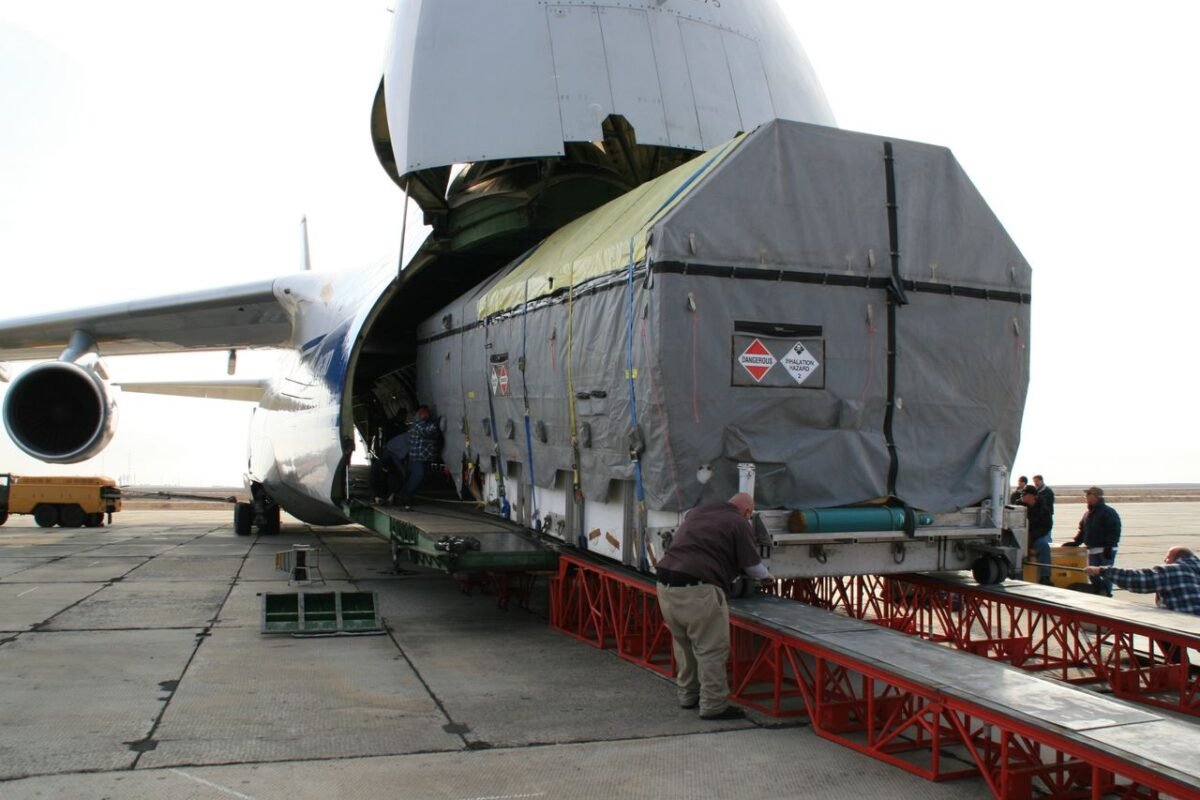
Outsized cargo. Some equipment simply does not fit through the side cargo door of the aircraft types that serve the route. Main-deck freighters with nose doors can accept longer and taller pieces, and specialist heavy-lift aircraft exist for the rare items beyond that. If a piece is too large for scheduled freighters, the choice is between a charter and sea freight as break bulk or on a flat rack.
Very high-value downtime. When a factory is stopped, the cost of waiting can dwarf the freight bill. But even here, a single spare part rarely justifies a charter; an urgent scheduled or courier shipment usually does the job.
Large, time-critical consignments in peak season. During peak periods, scheduled space from Chinese gateways can be embargoed or heavily rolled, as we describe in peak season air freight. A shipper with enough cargo to fill most of a freighter may find a charter more reliable than fighting for space.
What drives the cost of a charter
We do not publish charter prices, because they move with fuel, aircraft availability, season and routing, and any figure would be out of date quickly. What we can explain is the mechanism, which matters more than the headline number:
- Positioning and return legs. A one-way charter from China to Dhaka usually has to pay for the aircraft to get there and, often, to fly back empty or to its next job. If there is no return cargo, the charterer effectively pays for both directions.
- Aircraft type. Larger freighters cost more per flight but can be cheaper per kilo when full. Choosing an aircraft that is too big wastes money; choosing one too small risks the cargo not fitting.
- Airport charges at both ends. Landing, parking, ground handling and fuel costs vary by airport and are usually passed through.
- Permits. Non-scheduled flights need permission from the Civil Aviation Authority of Bangladesh and from the authorities at origin, and sometimes overflight permissions en route. The time needed to obtain them affects how quickly a charter can operate.
- Load factor. The single biggest variable. A charter carrying half the weight it could carry costs almost the same as a full one.
Practical steps to arrange a charter
1. Measure and weigh every piece accurately, including crating. Charter brokers match cargo to aircraft by door size, floor loading limits and total payload, so estimates are not good enough. A piece that is a few centimetres too tall for the door is a failed flight.
2. Check for dangerous goods. Machinery with fuel, batteries or refrigerant needs a dangerous goods declaration and may need draining or special packing.
3. Confirm handling at Dhaka. Outsized pieces need suitable loaders and trucks at Hazrat Shahjalal International Airport and a route from the airport to the destination that can take the load. Our guide to Dhaka airport cargo clearance covers the clearance side.
4. Prepare clearance documents in advance. A charter that lands in hours is wasted if the goods then sit in the cargo village for days waiting for permits or a Bill of Entry.
5. Read the charter agreement carefully, particularly the cancellation terms, what happens if loading is delayed, and whether airport charges are included.
Common mistakes
- Chartering for urgency alone. If the cargo would fit on scheduled flights, splitting it across several flights or using a priority service is usually far cheaper. See split shipments.
- Underestimating ground time. The flight may take hours, but trucking to the Chinese airport, export customs, loading, and Bangladeshi clearance can take days.
- Ignoring the sea option. For oversize machinery that is not urgent, sea freight is almost always the sensible choice; compare with our sea versus air guide.
- Not insuring the cargo. Carrier liability under air conventions is limited by weight, not value. Arrange cargo insurance for high-value pieces.
A realistic decision rule
Start with the question: does the cargo physically fit on scheduled aircraft on this route? If yes, a charter is only worth pricing when you have enough volume to fill most of an aircraft and scheduled space is genuinely unavailable in your time window. If no, compare a charter against sea freight on the basis of total cost including downtime, not freight alone. In most cases we see, the honest answer is a well-planned scheduled or sea shipment rather than a charter — but for the few cases where a charter is right, planning the details carefully is what makes it work.
Documents and liability on a charter flight
A charter changes the commercial arrangement with the airline, but the cargo still needs the same paperwork as any other air shipment. A master air waybill is issued for the flight, and if a forwarder has sold part of the space to several shippers, each shipper receives a house air waybill. Customs in Bangladesh clears the goods against the air waybill, commercial invoice, packing list and any permits the Import Policy Order requires, exactly as it would for scheduled cargo. The charter agreement itself is a contract between the charterer and the operator; it governs price, timing and cancellation, not customs.
Liability deserves attention. The carrier’s liability for loss or damage is generally limited by the applicable air convention to an amount per kilogram, which is far below the value of most machinery or electronics. The charter agreement may also contain its own limits and exclusions, and in a part charter arranged by a forwarder there may be several contracts between you and the aircraft operator. The safest approach is to assume the carrier will not cover the full value, read the conditions of contract, and insure the cargo separately for its full value including freight.
Talk to DE International
If you have oversized or time-critical cargo from China, send us the dimensions, weights and deadline and we will compare scheduled options, part charter and sea freight honestly before you commit. See our full range of import, freight and clearance services, China sourcing and buying agent service, browse the shop, or contact us for a quote built around your product and volume.
