
Import & Export Guides
Fruit and Vegetable Pack Houses: What a Post-Harvest Pack House in Bangladesh Needs
Sep
A pack house is where a field crop becomes a graded, cooled, labelled product ready for a buyer — a supermarket, an exporter, a processor. In Bangladesh most produce still skips this step: it goes from the field into sacks and onto a truck, and a large share is lost or downgraded before it is sold. A properly laid-out pack house is one of the highest-return investments in the whole cold chain, because it is where quality is captured and post-harvest loss is stopped. This is what one actually contains.
What a pack house is for
Three things happen in a pack house, in order: the produce is cleaned and sorted so that only sound units go forward; it is cooled quickly to remove field heat and slow deterioration; and it is packed and labelled to a specification the buyer has set. Do these well and the same field crop fetches a higher price, travels further, and arrives with far less waste. Skip them and the crop is sold ungraded at whatever the local market pays that day, with spoilage baked into every consignment.
The line, station by station
A working pack house is a flow, not a room. From receiving to dispatch:
- Receiving and shaded holding. Produce comes in out of the sun immediately — a covered, ventilated dock. Field heat is the enemy and it starts being removed the moment the crop arrives.
- Tipping and preliminary sort. Obvious rejects — rots, severe damage, foreign matter — are pulled before anything else so they do not contaminate the line.
- Washing / cleaning. Where the crop needs it, a wash tank or spray bar with clean, sanitised water, followed by drainage or air drying. Not every crop is washed — some store better dry.
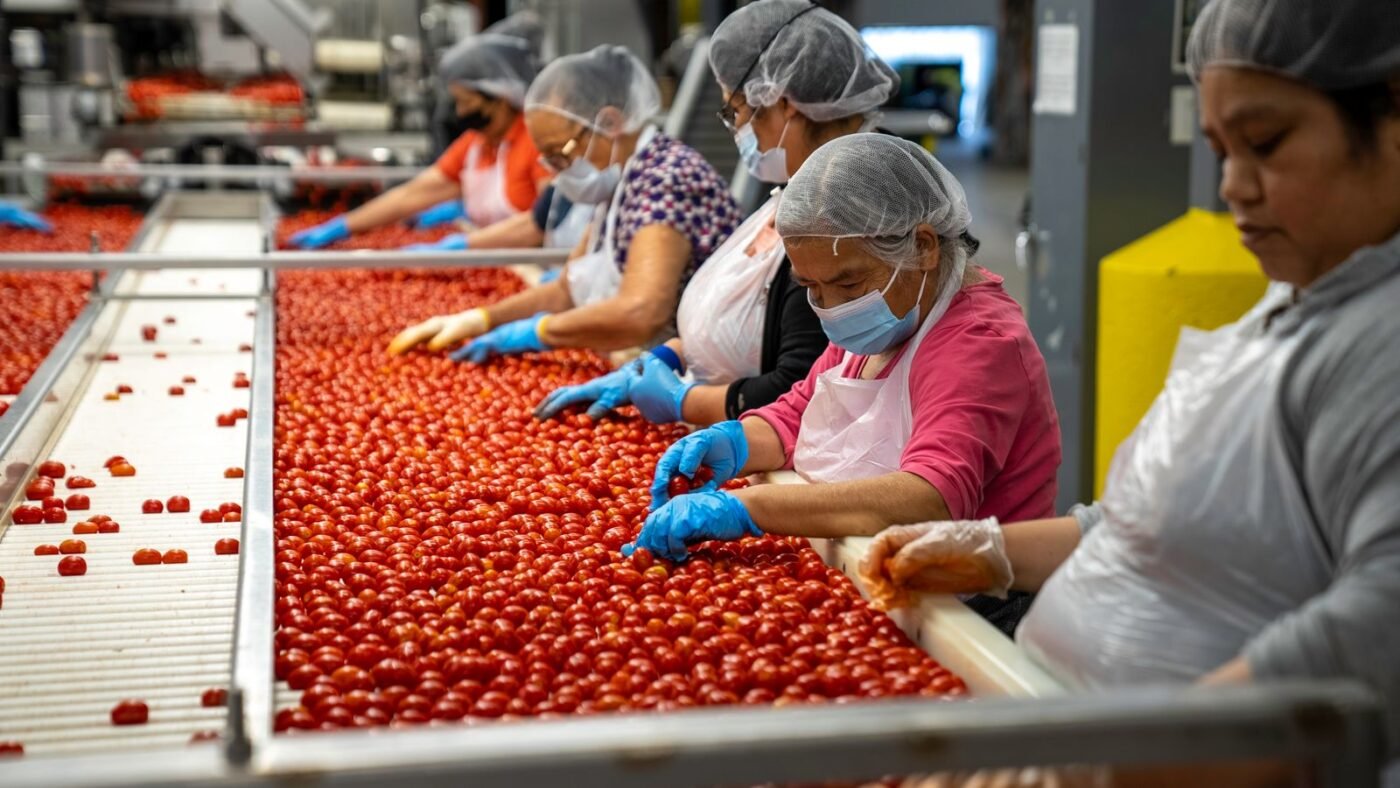
- Grading and sizing. Sorting by quality class and by size, either by hand on a sorting belt or with sizing equipment. This is where the buyer specification is enforced.
- Pre-cooling. The critical step — forced-air, room or hydro cooling to pull the core temperature down fast before packing. A carton packed warm carries its heat into the cold store and never fully recovers.
- Packing. Into the buyer’s cartons, crates or punnets, with liners, pads or modified-atmosphere bags as specified, at target weights.
- Labelling and palletising. Each carton labelled with product, grade, count, pack date and traceability code; cartons stacked to a stable pallet pattern.
- Cold storage and dispatch. Finished pallets held in a holding cold room at the crop’s storage temperature until a refrigerated vehicle takes them.
The services and structure behind the line
- Reliable power with backup. Pre-cooling and cold rooms cannot tolerate long outages; a generator sized to the refrigeration load is not optional in Bangladesh.
- Clean water at the volume the wash step needs, with a way to sanitise it and manage the wastewater.
- A hygienic building shell — smooth washable floors that drain, sealed walls, insect screening, no nesting points for birds or rodents.
- Separation of dirty and clean zones so field crates and rejects never cross the packed-product area.
- Enough refrigeration for both the pre-cool duty and the holding store — they are different loads and are often undersized when combined.
Sizing it to the crop and the season
The commonest planning error is designing for an average day. Produce arrives in peaks — a mango or tomato flush lands most of the crop in a few weeks — and the pack house has to move that peak through in a day, not a week, or the produce waits and deteriorates. Receiving area, line speed, pre-cooling capacity and holding-store volume all have to be sized to the peak intake for the specific crops you handle. Because that depends entirely on your crop mix, your catchment and your buyers, the throughput and refrigeration figures are worked out per project rather than taken from a standard model.
Common mistakes
- No pre-cooling. A pack house with grading and a cold room but no forced-air or hydro pre-cool is packing field heat into cartons and expecting the holding store to fix it. It cannot.
- Holding store used as a pre-cooler. Warm cartons dumped into the holding room push its temperature up and slow-cool in the middle of the pallet.
- Grading to no fixed standard, so consignments vary and buyers stop trusting the pack.
- Undersized generator, so an outage during the peak undoes a day of work.
- Dirty-to-clean flow crossing over, re-contaminating washed produce.
- No traceability coding, so a quality complaint cannot be traced back to a field or a day and the whole batch is suspect.
Related reading: pre-cooling methods compared, reducing post-harvest loss, cold chain logistics for agriculture and cold chain for mango export. See our services, contact DE International, our sourcing service and shop.
