Import & Export Guides
From Idea to Product: How to Get a New Product Manufactured in China
Jun
Some businesses do not just want to rebrand an existing product — they have an idea for something new. China is where most new consumer products are tooled and made, and you do not need to be a big company to do it. This guide walks through turning an idea into a finished product: the specification, prototypes, tooling, and the realistic costs and minimums involved.
OEM vs ODM: how much are you really changing?
Before tooling anything, be honest about how custom you need to be:
- Rebrand (private label): an existing product with your logo — cheapest and fastest.
- Modify (light ODM): an existing design with changes to colour, material or small features.
- Full custom (OEM): a new design that needs new tooling or moulds — highest cost and minimum.
Most first products are a rebrand or a light modification. Full custom tooling is worth it only when the design is genuinely new and the volume justifies it. Our OEM and private label guide covers the simpler routes.
Write a clear product specification
Factories quote and build from your spec, so make it precise:
- Function: what the product does and how it is used.
- Dimensions and materials: sizes, materials and finishes.
- Drawings or reference samples: a sketch, a 3D file or a similar product to copy from.
- Standards: any voltage, plug or safety requirement for Bangladesh.
- Packaging: how it should be boxed and labelled.
Prototype before you tool
A prototype is far cheaper than a wrong production run:
- Get a sample or 3D-printed prototype to hold and test.
- Test it in real conditions — power, climate, handling.
- Revise the spec based on what you learn.
- Approve a final pre-production sample before bulk.
Always order a sample before bulk production — it is the single best protection against an expensive mistake.
Tooling, moulds and what they cost
New parts often need tooling, and tooling changes the economics:
- Moulds are a one-time cost paid up front before production.
- Tooling raises the minimum order so the factory can recover its setup.
- Plain or existing parts avoid tooling and lower the entry cost.
Tooling and unit prices vary too widely to quote here — they depend entirely on the product. Ask for a quote on your specific design, and use our landed-cost guide to plan the full budget including freight and duty.
How DE International manages product development
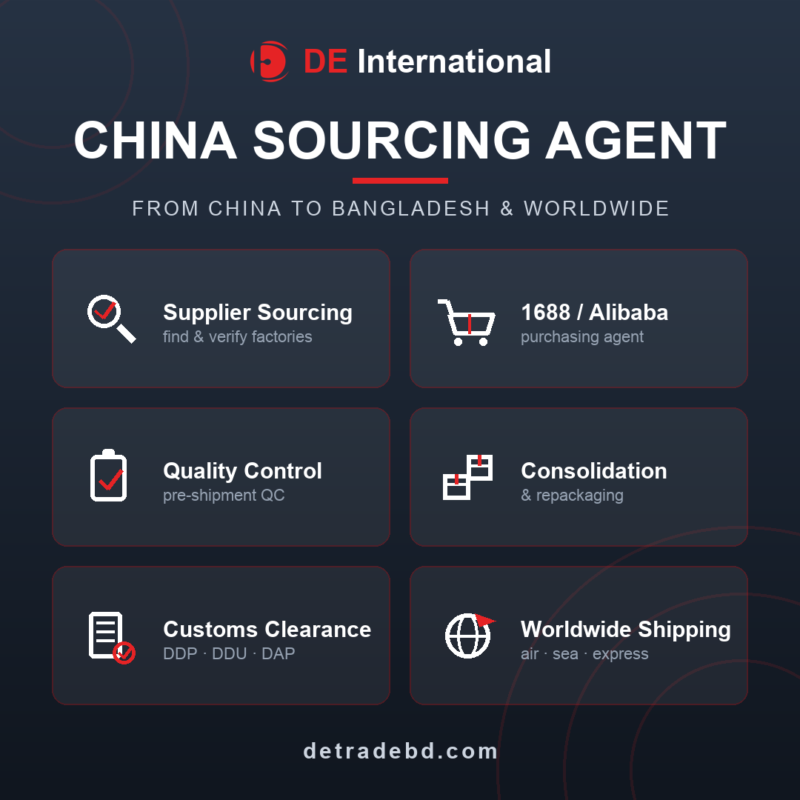
Developing a product across a language gap and a time zone is hard to do alone. DE International can find capable factories, pass them your spec and drawings, manage prototype rounds, inspect the result, and ship it to Bangladesh. Start with our beginner guide to sourcing and the role of a sourcing agent if this is new to you.
Have an idea? Tell us what you want to make, share any sketches or samples, and we will come back with factory options, a prototype plan and a quote. See our services, our sourcing and buying agent service, or contact us.
Frequently Asked Questions
What is the difference between OEM and ODM?
OEM means manufacturing a product to your own specification and branding; ODM means adapting an existing factory design with lighter customization — the guide above explains how to judge which applies to your project.
Do I need a prototype before mass production?
Yes, generally — prototyping before tooling catches design issues while they are still cheap to fix, rather than after a mould has already been cut.
How much does tooling cost?
This varies significantly by product complexity and mould type — see the tooling section above for realistic cost ranges and what drives them.
Prefer to talk it through?
✉ Chat on WhatsApp for a Quote