
Import & Export Guides
Pallet Racking vs Floor Stacking: Getting the Most Storage Out of Your Warehouse
Aug
Most importers start out floor stacking, and there is nothing wrong with that — it costs nothing beyond the warehouse rent itself, and for a business moving a handful of SKUs through a small space, it is genuinely the right call. The problem is that floor stacking has real physical and operational limits that racking does not, and a lot of businesses only discover exactly where those limits sit after they have already run into them: a crushed carton, a stock rotation nightmare, or a warehouse that is technically full at half its usable height.
The Physics of Floor Stacking
Every carton has a maximum compression load it can bear before it starts to deform, and that limit is what actually caps how high you can safely floor-stack goods — not the height of your warehouse ceiling. Stack cartons of the same product too high and the bottom layer starts to bow or collapse under the weight of everything above it, sometimes gradually enough that the damage is not visible until you unstack and find crushed product or bent packaging. This means a warehouse with 20-foot ceilings floor-stacking cartons that can only safely go six or eight high is using a fraction of its actual cubic capacity, no matter how efficiently the floor space itself is arranged.
What Pallet Racking Actually Solves
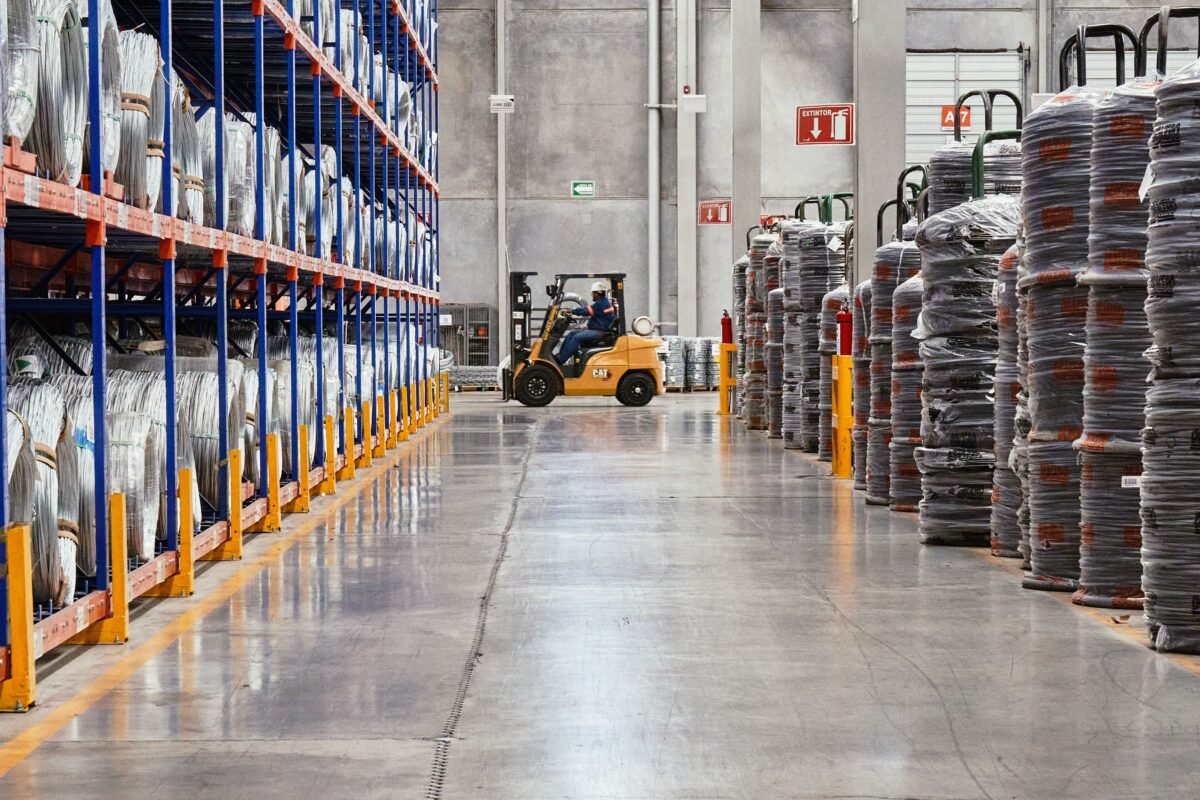
Selective pallet racking — the standard steel-frame racking most warehouses eventually install — solves the compression problem by transferring the load-bearing to the racking structure instead of the cartons themselves. Each pallet sits on its own beam level, so the weight of the pallet above never rests on the goods below. This lets a warehouse use its full vertical height, often multiplying usable storage capacity within the same floor footprint compared with floor stacking the same goods. The image on this page shows a typical selective racking aisle: a forklift can drive straight down the aisle and access any pallet position directly, without needing to move other pallets out of the way first.
The FIFO Problem Floor Stacking Creates
Beyond the physical compression limit, floor stacking creates a stock rotation problem that matters enormously for any importer carrying dated, seasonal, or fast-moving goods. When cartons are stacked deep and high on the floor, the units at the back or bottom of a stack — often your oldest stock — are physically the hardest to reach, which pushes staff toward picking whatever is easiest to grab rather than what should move first under a proper First In, First Out (FIFO) system. Selective pallet racking, by giving direct access to every pallet position, makes FIFO discipline dramatically easier to enforce in practice, not just on paper.
The Capital Cost Trade-Off
None of this makes racking free, and that is the real trade-off. Steel selective racking is a capital investment — the frames, beams, and installation add real upfront cost, and depending on your racking height, you may also need a forklift with greater lift capability than floor stacking required, since a reach truck or narrower-aisle forklift is often needed to work taller racking efficiently. For a business still finding its footing on volume and SKU count, that capital outlay does not always make sense yet, which is exactly why floor stacking remains the right choice for many smaller importers — the question is not which system is universally better, but which one fits your current volume and growth trajectory.
Beyond Selective Racking: Denser Options
Selective racking is not the only option once you move away from floor stacking. Drive-in racking allows a forklift to drive directly into the racking structure to place or retrieve pallets, achieving much higher storage density than selective racking at the cost of direct access — it works on a last-in-first-out basis for each lane, which makes it a poor fit for FIFO-sensitive goods but a strong fit for large volumes of a single non-perishable SKU. Push-back racking sits somewhere between the two, using a sloped rail system that lets multiple pallets nest per lane while still allowing reasonably good access. Choosing between these options depends heavily on how many distinct SKUs you carry and how strictly you need to enforce stock rotation.
A Practical Way to Decide Where You Stand
A reasonable rule of thumb is to reassess your storage system whenever you notice any of three signs: cartons showing visible compression damage before you sell through them, staff regularly struggling to reach or identify older stock buried in a stack, or your warehouse feeling full while a walk-through shows plenty of unused ceiling height above the current stacking. Any one of those is a signal that the cost of continuing to floor stack — in damaged goods, inefficient picking, or wasted rent on unused vertical space — may already exceed the capital cost of installing racking.
- Floor stacking height is limited by carton compression strength, not ceiling height — check for bottom-layer damage as an early warning sign.
- Selective pallet racking gives direct access to every pallet, making FIFO stock rotation far easier to enforce.
- Racking requires upfront capital investment and often a forklift upgrade — it is not the right call for every stage of growth.
- Drive-in racking maximises density for single-SKU bulk storage but works on a last-in-first-out basis.
- Reassess your storage system when you see carton damage, rotation problems, or unused vertical space, whichever comes first.
Aisle Width and the Forklift You Actually Need
Racking density is not just about the frames themselves — it is closely tied to the aisle width your material handling equipment needs to operate in, and this is a decision worth making before racking is installed rather than after. Standard counterbalance forklifts, the type most small importers already own for floor stacking and loading trucks, generally need wider aisles to manoeuvre and turn, which eats directly into the storage density gain that racking is supposed to deliver. Narrower-aisle reach trucks recover more of that density but represent an additional equipment cost on top of the racking itself, and are generally less versatile outside the warehouse than a standard forklift. Planning aisle width and equipment together, rather than installing racking first and discovering the aisle is too narrow for the forklift you already own, avoids an expensive rework.
Floor Loading Capacity Is Easy to Overlook
One constraint that catches importers off guard when they first move to racking is the floor itself. A loaded pallet racking system concentrates significant weight onto a small number of upright footplates rather than spreading it across the full floor area the way floor-stacked cartons do, and not every warehouse floor — particularly older buildings not originally designed for racked storage — is rated to handle that concentrated point loading safely. Before committing to a racking installation, it is worth having the floor’s load rating checked against the racking supplier’s specifications, especially in a converted or older warehouse building rather than one purpose-built for logistics use.
Planning Your Warehouse Setup With Us
Getting the storage system right affects everything downstream, from how fast you can pick and pack orders to how much stock damage eats into your margin. At DE International we help importers plan warehouse storage alongside their import volumes, and can also source racking systems and material handling equipment directly from China where that makes sense for your setup. Reach out to our team to talk through your current storage constraints, or browse our shop and sourcing and buying agent service.
