
Import & Export Guides
Refrigerant Leaks in Mini Cold Storage: Signs, Detection and Proper Repair
Oct
A mini cold storage that slowly stops reaching its set temperature rarely fails overnight. More often, the owner notices the compressor running longer than usual, the room taking longer to pull down after the door has been opened, and frost forming in odd places. In a large share of these cases the root cause is a refrigerant leak. The usual response — calling a technician to “add gas” — restores cooling for a while, but if the leak itself is not found and fixed, the room will be back in the same state soon, having cost money each time.
This guide explains why refrigerant leaks happen in small cold rooms, how to recognise the symptoms early, how technicians actually find leaks, and why a proper repair always includes more than topping up the system.
Why refrigerant should not need topping up
A refrigeration system is a sealed loop. The refrigerant circulates between the evaporator inside the room, the compressor, the condenser outside, and the expansion device, changing between liquid and vapour as it absorbs and rejects heat. It is not consumed. In a correctly built and maintained system, the refrigerant charge should stay the same for years. If a system needs gas, the only honest explanation is that some has escaped — which means there is a leak somewhere.
This point matters because some service providers treat regular gas top-ups as normal maintenance. They are not. Each top-up without repair releases more refrigerant into the atmosphere, adds to your running cost, and allows the system to run undercharged between visits, which itself causes damage. For background on the refrigerants used in modern units, see our guide to refrigerant choices for mini cold storage.
Early warning signs of a leak
An undercharged system usually shows a cluster of symptoms rather than one clear signal. Watch for:
- Longer run times. The compressor runs almost continuously but the room struggles to reach setpoint, especially in hot afternoons.
- Slow pull-down. After loading fresh produce or opening the door, the temperature takes much longer to recover than it used to.
- Unusual frost pattern. Frost forming only on part of the evaporator coil, or on the suction line near the expansion valve, can indicate low refrigerant flow.
- Oily spots. Refrigerant carries compressor oil with it. An oily stain or dust collecting on a joint, valve or flare nut is a classic sign of a leak at that point.
- Hissing or bubbling sounds near pipework, in more serious cases.
- Rising electricity bills without any change in how the room is used.
A good digital controller with alarm logging makes these trends easier to spot; our guide to controller setpoints and alarms explains what to monitor.
Where leaks usually happen in small cold rooms
Leaks are rarely random. They tend to appear where the system experiences vibration, temperature cycling or poor workmanship:
- Flare joints and service valves — flare nuts loosen over time with vibration and thermal expansion, and Schrader cores on service ports can fail.
- Brazed joints made during installation, particularly if the brazing was rushed or done without nitrogen purging.
- Evaporator coils — corrosion from cleaning chemicals, fish or salt-laden produce, or acidic environments can create pinholes in the tubes.
- Condenser coils exposed to coastal air, especially in areas such as Chattogram, Cox’s Bazar or Khulna.
- Capillary tubes and small-bore pipes that rub against a frame or each other when the unit vibrates.
- Pipe runs through walls where insulation and sleeving were skipped, leading to abrasion.
Installation quality has a big influence on how many of these problems appear later. Our installation and commissioning guide covers the pressure and vacuum tests that should be done before the system is charged.
How technicians find a leak
Finding a leak properly is a step-by-step process, and it is worth knowing what a competent technician should be doing:
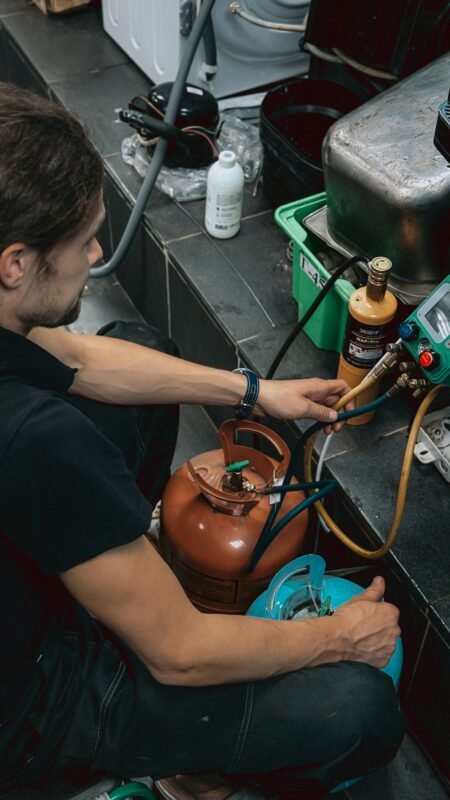
- Gauge readings first. Manifold gauges on the suction and discharge sides, combined with temperature readings, help confirm whether the system is actually undercharged or has another fault such as a dirty condenser or failing fan.
- Visual inspection. Checking every joint and valve for oil traces is fast and often finds the leak.
- Soap bubble testing. A soap or commercial bubble solution brushed onto suspect joints will foam where gas escapes. It is simple and effective for accessible points.
- Electronic leak detector. A handheld sensor sniffs for refrigerant along pipework and coils, useful for finding small leaks in hard-to-see places.
- UV dye. In some cases a dye is added to the system and a UV lamp used later to spot where it has escaped.
- Nitrogen pressure test. For stubborn leaks, the refrigerant is recovered and the system pressurised with dry nitrogen, then monitored for a pressure drop. This also confirms the repair afterwards.
A technician who skips straight to adding gas without any of these steps is not repairing your system.
What a proper repair includes
Once a leak is found, a correct repair follows a sequence. The remaining refrigerant should be recovered rather than vented. The faulty joint is re-made, a valve core replaced, or a damaged coil section repaired or replaced. The system is then pressure-tested with nitrogen, evacuated with a vacuum pump to remove air and moisture, and recharged by weight to the manufacturer’s specified charge, not “by feel.”
The evacuation step is often skipped and is very important. Moisture left in the system can combine with refrigerant and oil to form acids, which attack compressor windings and valves over time. A drier replacement is also commonly recommended after the system has been opened.
| Approach | Short-term result | Long-term effect |
|---|---|---|
| Top-up only | Cooling restored temporarily | Leak continues, repeated cost, compressor stress |
| Find and fix leak, no evacuation | Cooling restored | Moisture risk, possible acid formation |
| Find, fix, pressure-test, evacuate, charge by weight | Cooling restored | System returns to sealed, stable condition |
Why running undercharged damages the compressor
Many compressors used in mini cold storage units are cooled by the returning suction gas. When refrigerant is low, less gas returns, so the compressor runs hotter. Oil that should circulate with the refrigerant can also be left in the evaporator instead of returning to the compressor. Running hot and short of oil for long periods is a common path to compressor failure — usually the most expensive single repair on a cold room. For an overview of compressor types and how they behave, see our article on compressor types explained.
Preventive habits that reduce leaks
- Include a leak check and oil-trace inspection in every scheduled service visit, as described in our maintenance guide.
- Keep a simple log of gas additions. More than one top-up in a year is a strong signal of an unresolved leak.
- Protect outdoor condensers from salt air and direct physical damage, and clean coils with suitable, non-corrosive cleaners.
- Make sure pipework is clamped and sleeved where it passes through walls or frames, so vibration does not cause rubbing.
- Ask your supplier what the warranty covers for leaks in the first period after installation, and keep the commissioning records.
When we supply mini cold storage systems from China, we can help you check build quality, specify the refrigerant and components, and connect you with installation and after-sales support. Every room is different in size, product and climate, so the right setup depends on your specific needs.
Questions to ask a technician before work starts
Before agreeing to any refrigerant work, ask the technician three simple questions. How will you find the leak? Will you recover the remaining gas, pressure-test and vacuum the system before recharging? How much refrigerant will you charge, and how will you measure it? A technician who can answer clearly, and who writes the leak location and the charge weight on the service report, is giving you a repair you can verify. Keep those reports together; if the same joint leaks twice, you have evidence to raise with the installer or the supplier under warranty.
Every product, factory and shipment is different, so we do not publish fixed fees or timelines for mini cold storage supply and servicing. Tell us what you are importing and ask us for a quote built around your needs. You can also browse our full list of services, see how our China sourcing and buying agent service works, or explore products in our shop.
