
Import & Export Guides
Shipping Bulk Liquids from China: Flexitank vs ISO Tank vs Drums and IBCs
Oct
Liquid cargo — edible oils, glycerine, latex, non-hazardous chemicals, syrups, lubricants, liquid fertiliser, industrial additives — moves from China to Bangladesh in very different packaging depending on volume and product. A small factory might buy a few drums of a resin or additive; a larger manufacturer might need a full container of a single liquid every month. The packaging choice affects freight cost, safety, product quality, port handling and even how easily customs can examine the goods.
This guide compares the four main options for bulk liquids by sea: drums, IBC totes, flexitanks and ISO tank containers, and explains what importers should check before choosing.
The four options at a glance
| Packaging | How it works | Typically suits |
|---|---|---|
| Drums | Steel or plastic drums, palletised and loaded into a standard container | Small quantities, multiple products, hazardous liquids in approved drums |
| IBC totes | Plastic intermediate bulk containers in a metal cage, on an integrated pallet | Medium quantities, products used in batches at the factory |
| Flexitank | A single-use multi-layer bag fitted inside a standard 20ft container | Large volumes of a single non-hazardous liquid |
| ISO tank | A stainless steel tank in a container-sized frame, reusable | Large volumes, hazardous or sensitive liquids, temperature-controlled liquids |
The right choice depends on four questions: how much liquid you buy at a time, whether the product is classified as dangerous goods, how sensitive it is to contamination or temperature, and what equipment you have to unload it at your premises.
Drums and IBCs: flexible but space-hungry
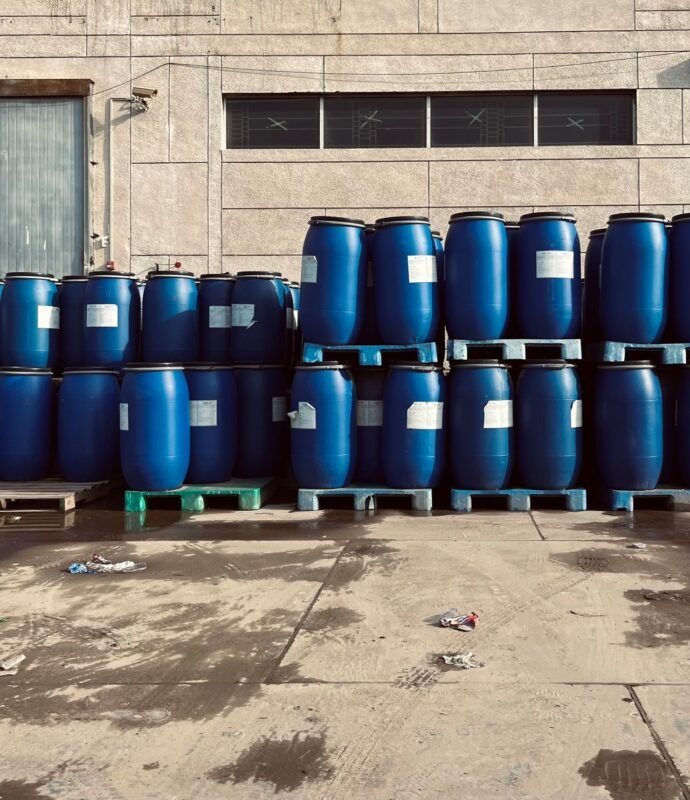
Drums and IBCs are the most familiar option and the most flexible. A single container can carry several different products, each in its own drums. They can be unloaded with a forklift, stored in a warehouse, and used one at a time. For a factory that consumes a liquid gradually, this is often more practical than receiving a full container load at once.
The trade-off is efficiency. Round drums leave unused space between them, and the packaging itself adds weight and cost. Drums and IBCs also need to be properly secured inside the container so they do not shift and puncture; our article on cargo securing, lashing and dunnage explains why poor stowage is a frequent cause of liquid cargo claims. Wooden pallets used under drums must meet ISPM 15 treatment rules — see our guide to ISPM 15 wood packaging compliance.
Flexitanks: high volume for non-hazardous liquids
A flexitank turns a standard 20ft dry container into a liquid carrier. A large multi-layer bag, typically made of polyethylene layers with a valve, is laid out inside the container, a bulkhead is fitted at the door end, and the liquid is pumped in at the origin. At destination, the liquid is pumped out and the bag is disposed of. Because it uses an ordinary container, a flexitank can be a cost-effective way to move large volumes of one product.
Flexitanks have important limits:
- Non-hazardous liquids only. They are generally not used for liquids classified as dangerous goods.
- Single product per container. You cannot mix products.
- Container condition matters. The container must be clean, dry and free of protruding nails or damage that could puncture the bag. A leak from a flexitank can contaminate the container and create claims from the carrier.
- Carrier acceptance. Shipping lines have their own approval requirements for flexitank shipments, and not every line or route accepts them on every booking. Confirm acceptance before the supplier fills the tank.
- Unloading equipment. You need a suitable pump, hoses and a receiving tank at your site. If the truck cannot reach your tank, the container may need to be discharged elsewhere.
Food-grade liquids such as edible oils require a food-grade flexitank and attention to the previous use of the container. Ask the supplier for documentation on the bag specification.
ISO tanks: the option for hazardous and sensitive liquids
An ISO tank is a pressure-rated stainless steel tank mounted in a frame with the same external dimensions as a 20ft container, so it can be handled by the same port equipment. Tanks are reusable, are cleaned between loads, and can be equipped with heating or insulation for products that must stay liquid or within a temperature range.
ISO tanks are commonly used for chemicals classified as dangerous goods, because the tank design, testing and documentation can meet the relevant transport rules. They are also preferred for high-value or contamination-sensitive liquids. The cleaning certificate showing what the tank previously carried and how it was cleaned is an important document — contamination from a previous cargo can ruin a shipment. Our article on shipping chemicals and hazardous cargo by sea covers the dangerous goods documentation side.
Because ISO tanks are owned or leased by tank operators, they must be returned after discharge. Delays in unloading can mean daily charges for keeping the tank, similar in principle to container detention. Our guide to demurrage and detention explains how these charges build up.
Customs and regulatory points in Bangladesh
Liquid imports often bring additional regulatory attention. Some chemicals require import permits or clearances from specific authorities, and certain substances are controlled; our article on precursor and controlled chemical imports covers one such category. Food liquids may need food safety documentation and testing. Customs may also take samples for laboratory testing to confirm the product matches its declared description and HS code, which can affect clearance time; see our guide to customs laboratory testing.
Make sure the Safety Data Sheet, certificate of analysis and any required permits are ready before the vessel arrives. Requirements depend on the exact product, so confirm them for your specific liquid early in the process.
Common mistakes with bulk liquid shipments
- Choosing flexitank for a hazardous product because it looked cheaper, then having the booking rejected.
- No unloading plan. The container arrives and there is no pump, no receiving tank, or no truck access.
- Ignoring the previous cargo of a tank or container, leading to contamination.
- Poor drum securing, resulting in shifting, punctures and leaks that damage other cargo.
- Missing SDS or certificate of analysis, which can delay both booking and clearance.
- Overfilling or underfilling. Tanks and flexitanks have recommended fill levels; liquid surging in a partly filled tank can stress the equipment.
Volume, product classification and your site facilities decide the best option, and the freight and handling costs vary accordingly. For broader context on container choices, see our guide to container types.
A simple way to decide
Start with classification. If the Safety Data Sheet shows the product is regulated as dangerous goods, rule out flexitanks and plan for approved drums, IBCs or an ISO tank, with the matching dangerous goods documentation. If it is non-hazardous, look at quantity and consumption. A factory that uses a liquid slowly, in small batches, often does better with drums or IBCs even if the freight per litre is higher, because it avoids needing a large receiving tank and avoids paying for storage of a whole container load at once.
If you buy large, regular volumes of one non-hazardous liquid and have a suitable tank and pump at your site, a flexitank is often worth evaluating. If the product is sensitive to contamination, must be kept warm to stay liquid, or is very high value, an ISO tank gives more control. Whatever you choose, ask the supplier to confirm the fill quantity, the packaging specification and the loading method in writing before shipment, and photograph the loaded container or tank before it is sealed.
Every product, factory and shipment is different, so we do not publish fixed fees or timelines for bulk liquid sea freight. Tell us what you are importing and ask us for a quote built around your needs. You can also browse our full list of services, see how our China sourcing and buying agent service works, or explore products in our shop.
