
Import & Export Guides
Door-to-Door Shipping of Glassware, Crockery and Ceramic Tableware from China to Bangladesh
Oct
Glass tumblers, dinner sets, ceramic mugs, serving bowls and restaurant crockery are among the steady sellers in Bangladeshi markets, from wholesale shops in Dhaka’s Chawkbazar and Nawabpur areas to online homeware stores and hotel suppliers. China is a major source for all of it. The products themselves are not complicated, but they are heavy for their value, they break, and if they are used for food they carry safety obligations that cheap suppliers sometimes ignore. Importers who treat tableware like any other general cargo often find that breakage quietly eats their margin.
This guide covers how to source and ship glassware and ceramic tableware from China to Bangladesh door to door with as little damage and risk as possible.
Where tableware is made in China
Chinese tableware production is concentrated in a few well-known clusters, and knowing them helps you judge whether a supplier is a real manufacturer or a trader:
- Chaozhou in Guangdong: one of the largest ceramic tableware and daily-use porcelain centres, from budget to hotel grade.
- Dehua in Fujian: known for white porcelain, ceramic gifts and decorative items.
- Jingdezhen in Jiangxi: the historic porcelain city, strong in decorative and premium pieces.
- Zibo in Shandong: ceramics and glass, including glass tableware.
- Various glassware producers in Shandong, Hebei and elsewhere supply tumblers, jars and machine-made glass.
Yiwu wholesale market also carries a wide range of tableware from these clusters, useful for mixed small orders. Our trading company vs factory guide explains how to tell which you are dealing with.
Why breakage happens and where
Glass and ceramics fail when they are hit, dropped, squeezed or vibrated against each other. On a China to Bangladesh door-to-door route, the cargo is handled many times: loading at the factory, trucking to the port or consolidation warehouse, loading into the container, transshipment, unloading at Chattogram, storage, trucking to Dhaka and delivery. LCL cargo is handled more than FCL because it is packed and unpacked at consolidation warehouses at each end. Every handling point is an opportunity for a drop.
Most breakage comes from three causes:
- Items touching each other inside the carton, so vibration chips rims and edges.
- Cartons too weak for the weight, so they collapse when stacked and crush the bottom layer. See our guide on carton stacking strength.
- Drops at corners and edges during manual handling.
Export packing that actually protects tableware
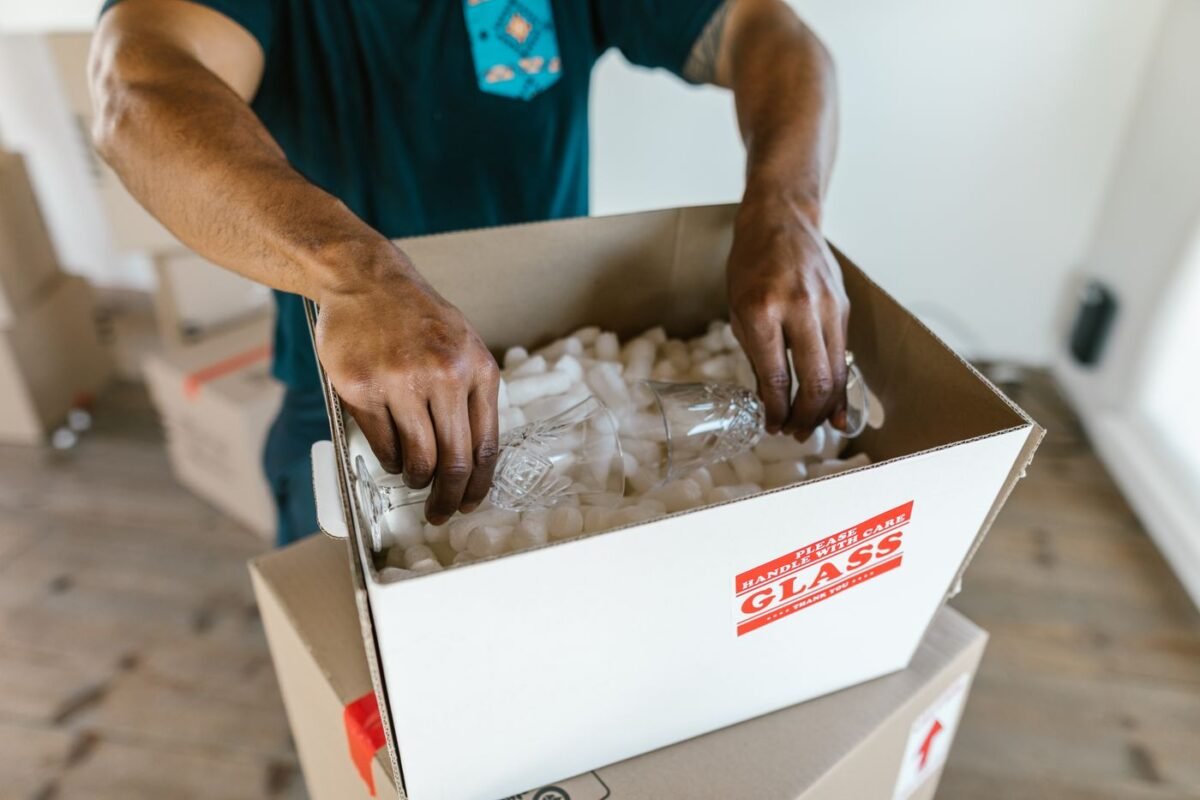
Retail gift boxes are designed for the shop shelf, not for an ocean voyage. For import shipments, specify export packing in your purchase contract, for example:
- Individual protection: each glass or plate wrapped, or held in a moulded tray or cardboard divider so pieces never touch.
- Inner boxes: sets packed in their own inner carton, which then sits inside a stronger master carton.
- Master carton: double-wall corrugated board appropriate to the weight, with no empty space at the top; void fill where needed.
- Weight limit per carton: heavy cartons are more likely to be dropped. Keep master cartons to a weight one person can handle safely.
- Fragile and this-way-up markings on all sides, plus clear shipping marks.
- Palletising for larger orders, with cartons stretch-wrapped and corner boards fitted.
Ask suppliers whether their export packing has been drop-tested. International test procedures such as those published by ISTA simulate drops and vibration on packed cartons; a supplier who exports regularly to demanding markets may already test to these. Even an informal drop test of one packed master carton, done on video before shipment, tells you a lot.
Food-contact safety: lead, cadmium and test reports
Ceramic glazes and decorations can contain lead and cadmium. If the glaze is poorly formulated or under-fired, these metals can migrate into acidic food or drinks. Decorations on the rim of glasses, where lips touch, are a particular concern. Reputable suppliers test their products for heavy-metal migration under recognised food-contact standards used in markets such as the EU and US, and can provide test reports.
For Bangladeshi importers, especially those supplying hotels, restaurants or modern retail, practical steps are:
- Ask for food-contact test reports for the exact item and decoration, and check the report covers your product rather than a different line. See how to verify test reports.
- Be cautious with very cheap brightly decorated pieces where no test report is available.
- Check whether your product falls under any BSTI requirements or other Bangladeshi rules before ordering. Our BSTI guide explains how to check.
Pre-shipment inspection for tableware
A short inspection at the factory before the goods are packed into the container catches most problems while they can still be fixed at the supplier’s cost. For glass and ceramics, an inspector typically checks:
- Chips, cracks and rough rims on a random sample, using an agreed sampling plan such as AQL. See AQL explained.
- Glaze defects: pinholes, crawling, uneven colour and decoration misalignment.
- Glass defects: bubbles, seeds, stones and uneven wall thickness.
- Set completeness: every set contains the right number of each piece.
- Packing against the agreed specification, including a drop test of a packed master carton.
- Shipping marks and carton counts against the packing list.
Inspection does not guarantee zero breakage in transit, but it separates factory defects from transport damage. That distinction matters when you claim from the supplier or the insurer, because a chip that was there before loading is the factory’s responsibility, not the carrier’s. Our guide on pre-shipment inspection explains how to arrange one.
Sea freight, LCL or FCL, and when air makes sense
Tableware is heavy and relatively low in value per kilogram, so sea freight is the normal mode. For small orders, LCL is the realistic choice, but it adds handling. Some importers reduce LCL risk by palletising their cargo so it is moved by forklift rather than by hand, and by asking for loading supervision. For larger regular orders, a full container loaded directly at the factory and opened only at your warehouse is usually the lowest-breakage option. Air freight is rarely economical for tableware except for samples or very high-value pieces. Our LCL vs FCL guide compares the two.
| Option | Breakage risk | Suits |
|---|---|---|
| — | — | — |
| LCL, loose cartons | Higher, many manual handlings | Small trial orders |
| LCL, palletised | Lower, forklift handling | Regular small orders |
| FCL loaded at factory | Lowest, minimal handling | Large or regular orders |
| Air freight | Low, but expensive per kg | Samples, high-value pieces |
Insurance and damage claims
Marine cargo insurance terms matter for fragile goods. Narrow cover such as ICC (C) mainly covers major casualties, not ordinary breakage. Broader all-risks cover, ICC (A), is more relevant, but policies for glass and ceramics often contain breakage clauses, excesses or require proper packing as a condition. Read the policy wording before shipping. Our guide to ICC A, B and C explains the clauses.
If damage happens, the evidence collected at delivery decides the claim:
- Inspect cartons before signing the delivery note, and write any visible damage on it.
- Photograph damaged cartons before opening, then the contents.
- Keep damaged goods and packing until the insurer or carrier says otherwise.
- Notify the forwarder and insurer promptly in writing.
Our article on cargo damage claims walks through the process.
Common mistakes
- Accepting retail gift boxes as shipping packaging: high breakage in LCL.
- Overweight master cartons: more drops and collapsed stacks.
- No food-contact test reports: risk to customers and to your reputation.
- Signing a clean delivery note without checking: weakens any claim.
- Choosing the cheapest insurance: ordinary breakage not covered.
Freight cost, packing upgrade cost and insurance premium all depend on the product, volume and route, so ask us for a quote built around your specific order.
DE International sources tableware from Chinese manufacturers, specifies export packing, arranges inspection and ships door to door to your shop or warehouse in Bangladesh. Explore our services, browse the shop, use our China sourcing and buying agent service, or contact us. Related: door-to-door shipping explained and handling fragile goods in the warehouse.
