
Import & Export Guides
Door-to-Door Shipping of Sewing and Garment Machinery From China to Bangladesh
Sep
Bangladesh has one of the largest garment industries in the world, and a steady share of the machinery that keeps it running comes from China: single-needle lockstitch machines, overlock and flatlock machines, button attaching and buttonholing machines, computerised embroidery machines, fabric cutting machines, spreading tables, steam irons and finishing equipment. Buyers range from large export factories to small tailoring units, subcontractors and training centres. What they share is a need for machines that arrive complete, undamaged and ready to run, without surprises at customs or at the factory door.
Door-to-door shipping puts all the steps — collection from the Chinese supplier, export clearance, freight, Bangladesh customs clearance and delivery to the factory — under one arrangement. This guide covers what is specific about shipping garment machinery that way.
How garment machines are usually packed
Most industrial sewing machines are shipped as separate components. The machine head is packed in its own carton, often with foam inserts, while the table top, the stand and the motor are packed separately, sometimes in flat-pack form. A single machine may therefore arrive as several pieces, and a factory order of dozens of machines as a large number of cartons that must be matched up on arrival. A clear packing list, carton numbering by machine type, and consistent shipping marks make the difference between a smooth installation and a day spent sorting parts.
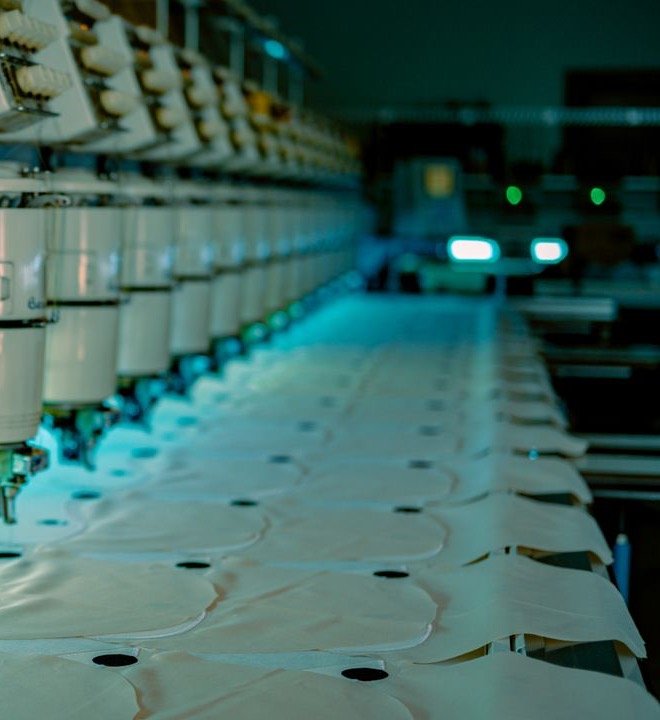
Larger equipment is different. Multi-head embroidery machines are long, heavy and precise, and are normally shipped in wooden crates or on skids with the frame secured. Automatic cutting systems and spreading machines may also be crated. Any wooden packaging must meet the ISPM 15 treatment standard, marked with the approved stamp, or it can be held for treatment on arrival; see our guide to ISPM 15 wood packaging.
Things buyers often overlook before shipping
- Voltage and phase. Most single-needle machines with servo motors run on single-phase supply, but some heavier equipment, such as certain cutting machines, boilers and pressing equipment, may need three-phase power. Confirm the electrical specification against your factory supply before the order is placed.
- Plugs and wiring. Machines may be supplied with plugs for the Chinese market. This is easily changed but should be planned.
- Lubrication oil. Oil-lubricated machines are often shipped with the oil reservoir drained to prevent leakage in transit. Running a machine before filling it can damage it. Check the manual before first use.
- Accessories and spare parts. Presser feet, bobbins, bobbin cases, needles and similar items are small and easily lost. Agree the accessory kit per machine and confirm it on the packing list.
- Software and language. Computerised machines and embroidery controllers should be set up with English menus and the correct design file compatibility for your existing software.
Customs classification and duty
Sewing machines are classified in the Harmonized System under heading 8452, while embroidery machines fall under heading 8447 together with certain knitting and related machinery. Cutting machines, pressing equipment and other items fall under their own headings depending on their function. Parts shipped separately may be classified differently from complete machines. The correct code determines the duty rate, so it is worth confirming classification before shipping rather than at the port. Our guide to HS codes for Bangladesh imports explains the principles.
Export-oriented garment factories may be eligible to import capital machinery at concessionary duty rates under Bangladesh’s industrial policy, subject to meeting the conditions and documentation requirements in force at the time. Whether a particular import qualifies depends on the factory’s status and registration, so confirm eligibility with your C&F agent or advisor before assuming a concession applies. Duty and taxes on your specific machines depend on classification and current rates, which is why we quote them per shipment.
New, used and reconditioned machines
China exports large quantities of reconditioned and used garment machinery as well as new equipment. Used machinery can be good value, but it brings extra import considerations in Bangladesh, including rules on the age and condition of second-hand capital machinery and the documents needed to support the declaration. The machines also need more careful inspection before shipping, because hidden wear in hooks, feed dogs and motors is not visible in photographs. Our article on clearing second-hand machinery covers the regulatory side.
A door-to-door order, step by step
For a typical factory order combining machines from more than one Chinese supplier, the door-to-door process runs in this order:
- Specification and order. Model numbers, motor type, voltage, accessory kits and packing method are agreed with each supplier in writing.
- Production and inspection. Machines are inspected and test-run before packing, as described below.
- Collection and consolidation. Cartons and crates are collected from each supplier and brought to a consolidation warehouse, checked against the packing lists and loaded into the container with heavy crates at the bottom and light cartons above, secured so nothing shifts.
- Export clearance and freight. Export customs formalities in China are completed and the container sails to Chattogram.
- Bangladesh clearance. The bill of entry is lodged with the correct classifications and supporting documents, duties and taxes are assessed and paid, and the goods are released.
- Delivery. The container or loose cargo is trucked to the factory, and unloading is planned with the equipment needed for crated machines.
Consolidation is where most sorting problems start or are prevented. A combined packing list covering every supplier, with carton numbers grouped by machine type, lets the receiving team check the delivery in an hour rather than a day.
Air or sea for garment machinery
For factory set-ups and bulk machine orders, sea freight is almost always the practical choice because of weight and volume. A full container load suits large orders; smaller orders can move as LCL alongside other cargo. Air freight makes sense for small urgent items — a replacement control board, a motor, or a set of specialised presser feet needed to restart a stopped line. Our comparison of sea freight and air freight discusses the trade-off.
Inspection before the machines leave China
A machine that arrives faulty is expensive to fix at a distance. Warranty claims against a supplier in another country are slow, and a stopped production line waiting for parts costs money every day. A pre-shipment inspection for garment machinery should check more than carton count:
- Run a sample of machines under power and sew test seams on appropriate fabric, checking stitch formation, tension and thread trimming where fitted.
- Confirm model numbers, motor type and voltage against the purchase order.
- Check that accessory kits and manuals are packed with each machine.
- For embroidery machines, run a test design across all heads and check colour change functions.
- Photograph packing, crating and shipping marks before the cartons are sealed.
See our guide to pre-shipment inspection for how inspections are organised.
Common mistakes and their consequences
| Mistake | Consequence |
|---|---|
| Machine heads, tables and stands not marked by set | Days lost matching parts during installation |
| Electrical specification not checked against factory supply | Machines cannot be connected until wiring or equipment is changed |
| Running machines before adding oil | Mechanical damage on first use |
| Untreated wooden crates for large machines | Held on arrival for treatment or re-packing |
| Assuming a duty concession applies without confirming eligibility | Unexpected duty at clearance and a delayed installation schedule |
DE International sources garment machinery from Chinese manufacturers and suppliers, arranges inspection, and handles door-to-door shipping, customs clearance and delivery to your factory. Costs depend on the machines, quantity, packing and route, so ask us for a quote built around your order.
Work With DE International
Related reading: door-to-door shipping for textile raw materials, shipping machinery and heavy equipment, customs clearance for machinery, and textile and bedding production machines. See our services, the China sourcing and buying agent service and shop, or contact us.
