
Import & Export Guides
Noodles Making Machine Price in Bangladesh: What an Instant Noodle Line Needs
Oct
Noodles making machine price in Bangladesh depends on the kind of noodle you want to make — fried instant noodles, non-fried (air-dried) instant noodles, or dry stick noodles — and on the output in packs per hour. An instant noodle production line is a chain of machines from dough mixing to steaming, frying and packing, plus a steam boiler. DE International sources noodle lines and individual machines from China and delivers door-to-door. Tell us your noodle type and target output, and ask us for a current quote for the full line.
This guide follows the dough through an instant noodle line so you can see what each machine does, then covers utilities, approvals and the mistakes that delay new noodle factories.
Which type of noodle are you making
| Type | Key process | Notes |
|---|---|---|
| Fried instant noodles | Steamed noodle blocks are fried in moulds | The familiar instant pack; needs frying oil system and oil management |
| Non-fried instant noodles | Steamed noodles are dried with hot air | Lower oil content; drying takes longer and needs a longer dryer |
| Dry stick noodles | Noodles are cut and hung or laid to dry slowly | Used for chowmein-style cooking; drying room control is critical |
| Fresh noodles | Made and sold the same day, chilled | Small machines for restaurants; short shelf life |
Each type needs a different line, so decide this first. Many Bangladeshi brands start with fried instant noodles because that is the largest retail category.
How an instant noodle line works, machine by machine
- Mixing. Wheat flour is mixed with salt water and alkaline salts (often called kansui, such as sodium or potassium carbonate), which give noodles their springy texture and yellow tone.
- Dough resting. The crumbly dough rests in a maturing conveyor so water spreads evenly.
- Compound sheeting. Two dough sheets are pressed together into one stronger sheet.
- Continuous rolling. A series of rollers thins the sheet step by step to the final thickness.
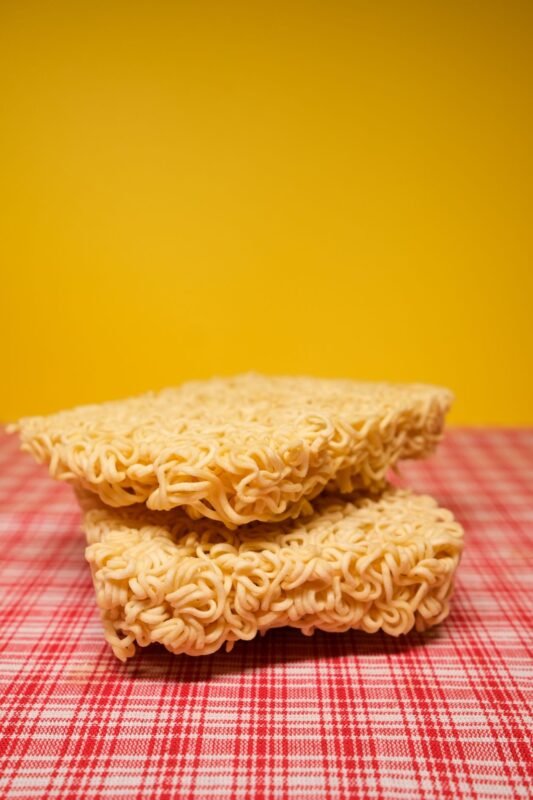
- Slitting and waving. Cutter rolls slit the sheet into strands. The conveyor below runs slower than the strands come out, so they bunch into the characteristic waves — which help noodles cook evenly and hold their block shape.
- Steaming. A steam tunnel cooks the starch in the noodles.
- Cutting and folding. The steamed noodle web is cut into portions and folded into blocks.
- Frying or air drying. Blocks go into moulds and through a fryer, or through a hot-air dryer for non-fried noodles.
- Cooling. A cooling tunnel brings blocks to room temperature so packs do not sweat.
- Packing. Seasoning and oil sachets are made on sachet machines, then a horizontal flow-wrap machine packs each block with its sachets.
What decides the price of a noodle line
- Capacity in blocks or packs per hour, which sizes every section.
- Fried or non-fried. The fryer with oil circulation, heat exchanger and oil filtration is a major cost item; air dryers are long and also costly.
- Automation. Automatic portion cutting, mould feeding and sachet dropping reduce labour.
- Material. Stainless steel food-contact parts and frames for wet areas.
- Sachet and packing machines. Powder and oil sachet machines plus the flow wrapper, and later a cup line if you plan cup noodles.
- Utilities. Steam boiler, thermal oil heater for the fryer, air compressor and cooling.
- Installation and training. A full line usually needs the supplier’s technicians on site.
- Landed cost. Freight, duty, VAT and inland transport for a line that may fill several containers.
We quote noodle lines against your output and noodle type rather than giving a fixed price. Ask us for a quote built around your plan.
Utilities and approvals you must plan for
The steam tunnel needs a boiler. In Bangladesh, boilers are regulated under boiler law and need registration and inspection through the Office of the Chief Inspector of Boilers before use, so include this in your project timeline. Frying lines need a reliable heat source, often a gas or oil-fired thermal oil heater, and a gas connection or fuel storage that meets safety rules. Power demand for a full line is substantial; confirm your sanctioned load before machines arrive.
Packaged noodles are food products. BSTI maintains a list of products needing mandatory certification, and labels must meet food labelling rules. Confirm the current requirements with BSTI and your consultant before launch. Our guides to BSTI certification and labelling requirements give background.
The seasoning sachet matters as much as the noodle
Customers choose noodle brands mostly on taste, and taste lives in the seasoning sachet. Noodle seasonings usually combine salt, sugar, spices, savory ingredients such as hydrolyzed vegetable protein, flavour enhancers, and sometimes caramel colour for a darker soup. Develop and test your seasoning in parallel with the line, not after. Our guide to HVP in chanachur, chips and noodles explains one key ingredient, and our sister company lists flavour enhancers and caramel colour used in noodle seasoning.
Testing the line before it ships
A noodle line is too large to fix easily once it arrives, so insist on a test run at the factory before you pay the balance. Ideally, send flour similar to what you will buy in Bangladesh, because flour protein and gluten strength change how the dough sheets and slits. During the test, watch and record:
- Whether strands break or stick at the slitter and how even the waves are.
- Block weight variation across a run — consistent weight protects both your margin and your declared net weight.
- Colour and crispness after frying, and whether blocks hold their shape.
- Sachet filling accuracy and seal strength on the sachet machines.
- Flow-wrap seal quality and how often the packer stops.
Agree in the contract that the supplier’s technicians will install and commission the line in Bangladesh and train your operators, and attach a list of spare parts and consumables that ship with the line.
Planning the building around the line
Instant noodle lines are long, and the layout must also leave room for flour storage, a dry seasoning room, the boiler and fuel area away from the production hall, and a finished-goods store. Steam and frying make the hall hot and humid; good ventilation keeps the work area tolerable and reduces condensation on ceilings that can drip onto product. Ask the supplier for a layout drawing based on your building measurements before you order.
Common mistakes
- Buying the line before securing utilities. A line without boiler approval or enough gas pressure sits idle.
- Underestimating oil management. Poor filtration darkens oil and shortens noodle shelf life.
- Ignoring floor layout. Instant noodle lines are long; measure the building before choosing the model.
- Skipping the cooling tunnel. Warm blocks packed immediately cause condensation inside packs.
- No spare parts plan. Cutter rolls, moulds and seals wear; order spares with the line.
FAQ
What is the price of a noodles making machine in Bangladesh?
It depends on noodle type, capacity and automation. DE International quotes complete lines; ask us for a current quote.
What does an instant noodle production line need?
Mixer, sheeting and rolling machines, slitter, steamer, cutter and folder, fryer or dryer, cooling tunnel, sachet machines and a flow-wrap packer, plus a boiler.
Fried or non-fried noodles: which is easier to start?
Fried instant noodles are the bigger market; non-fried lines avoid frying oil but need longer drying sections.
Do I need a boiler licence for a noodle factory?
Steam boilers in Bangladesh must be registered and inspected by the Chief Inspector of Boilers before use. Confirm current procedure.
Who can supply a noodle line from China?
DE International sources, inspects and ships food machinery door-to-door. WhatsApp +880 1750-859967.
See building a production line with China machines, our services, sourcing agent service and shop. Shipping a full line? Get a freight quote at decl.bd. Contact us or WhatsApp +880 1750-859967.
