
Import & Export Guides
Tracking Production in a Chinese Factory: Milestones, WIP Photos and DUPRO Inspection
Oct
The deposit has gone out, the proforma invoice is signed, and the factory says your order is “in production.” For many Bangladeshi importers this is where visibility stops. The next real information arrives weeks later, when the supplier announces the goods are ready and asks for the balance. If something went wrong in between — a material substitution, a missed colour, a line that was moved to a bigger customer’s order — you discover it at the worst possible moment, with most of your money already committed.
Production follow-up is the discipline of closing that blind period. It does not require living in China. It requires agreeing in advance what you will see and when, knowing what to look for in what the factory sends, and deciding where an independent pair of eyes is worth paying for. This guide walks through how that works in practice.
Why the production window is the riskiest part of an order
Before the deposit, you hold all the leverage: the supplier wants the order. After the balance, you hold almost none. The production window sits between those two points, and the problems that start there are expensive to fix later. A fabric dyed to the wrong shade cannot be undyed. Injection-moulded parts made from the wrong grade of plastic will not be re-melted for free. Cartons printed with the wrong barcode need to be reprinted and every unit repacked.
The underlying reason is simple economics. A factory running several customers’ orders on the same lines is constantly re-scheduling. Your order competes with others for machine time, for raw material allocation and for the attention of the same few supervisors. Without anyone asking questions, an order can slip down the queue quietly. Asking the right questions at the right moments keeps it visible.
Agree the milestones before you pay the deposit
The best time to set up follow-up is during negotiation, not after a problem appears. Put a short milestone schedule into the purchase contract or the proforma invoice, so updates are an agreed obligation rather than a favour. A practical milestone list for most consumer and light-industrial products looks like this:
- Raw material arrival — photos of the incoming material with its supplier label or batch tag visible, plus any mill certificate or material test report relevant to your product.
- First production pieces — photos and, ideally, a short video of the first units off the line, laid next to your approved golden sample.
- Mid-production status — a count of finished, semi-finished and not-started units, so you can judge whether the agreed ship date is realistic.
- Packing stage — photos of the inner packaging, the shipping carton, the shipping marks and the barcode labels before the cartons are sealed.
- Completion — the final packing list with carton count, net and gross weight and carton dimensions, which your forwarder needs for booking.
Notice that each milestone is tied to something physical you can check, not to a vague “progress update.” If you have not yet approved a reference sample, do that first — our guide to the golden sample approval process explains why every later check depends on it.
How to read WIP photos and videos critically
Work-in-progress photos are useful only if they actually prove something. A factory that wants to reassure you can send a beautiful photo of a product that is not yours, or a photo of five good units from a batch of five thousand. Train yourself to look for these signals:
- Is it your order? Ask for a handwritten note with your order number and the date to appear in the frame. It is a low-tech but effective way to stop recycled images.
- Is it the production line, not the sample room? Look for the surrounding environment — other units, the actual machines, carts of semi-finished parts. A single unit on a clean table proves little.
- Does it match the specification? Compare logo position, colour, stitching, finish and accessories against your product specification sheet, not against your memory.
- Are there quantities? A wide shot of racks of finished goods says more about real progress than ten close-ups.
- Is the video continuous? A short unbroken video walking from the material store to the line to the packing area is much harder to stage than separate stills.
Ask for numbers rather than adjectives. Our guide to communicating with Chinese suppliers on WeChat covers how to phrase questions so they get concrete answers.
During-production inspection: what DUPRO actually checks
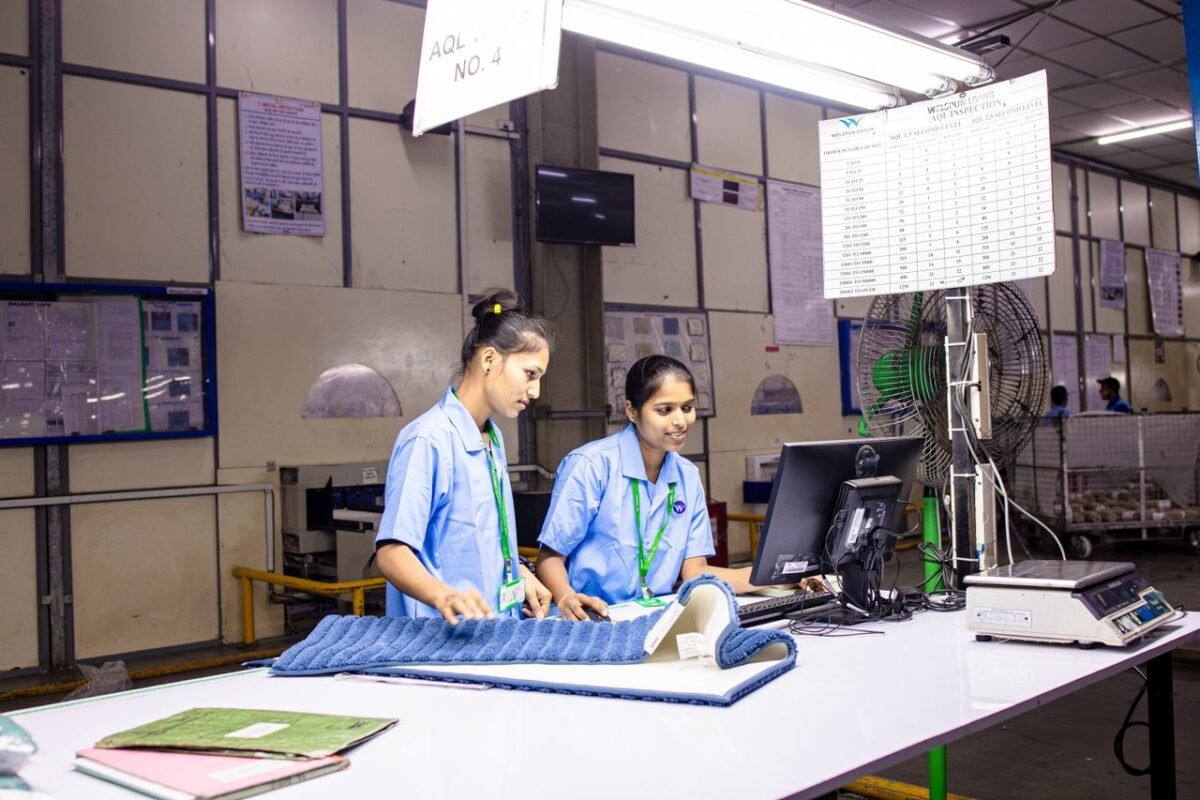
A during-production inspection, usually shortened to DUPRO or DPI, is carried out when a meaningful portion of the order has been produced but enough remains that problems can still be corrected on the rest. It is different from a pre-shipment inspection, which happens when goods are finished and packed. The key advantage of DUPRO is timing: a defect found here affects part of the order, not all of it.
A typical DUPRO visit covers:
- Checking raw materials and components in the warehouse against the agreed specification.
- Pulling a sample of finished and semi-finished units and inspecting them against the golden sample and the defect list.
- Watching the line to spot process problems — a worn mould, an untrained operator, skipped testing steps.
- Comparing the actual production status with the factory’s claimed status and the promised ship date.
- Reporting defects by category (critical, major, minor), with photos, so you can decide what to require before shipment.
Sampling levels and acceptance limits are normally based on an AQL table; if those terms are new to you, read our explainer on AQL and defect classification first. For simple, low-risk products, a pre-shipment inspection alone may be enough. For new suppliers, complex products, or orders where a reproduction would be very costly, DUPRO is often worth the additional visit.
Comparing your follow-up options
| Method | What it tells you | Main limitation |
|---|---|---|
| Supplier photos and videos | Rough progress, obvious errors in colour or branding | Supplier controls what you see |
| Video call walk-through | Live view of the line and stock, harder to stage | Camera angle still chosen by the factory |
| During-production inspection | Independent defect data while correction is still possible | Additional visit to plan and pay for |
| Pre-shipment inspection | Final quality and packing before the balance is paid | Problems found here affect the whole order |
| Local agent on the ground | Ongoing relationship, can visit at short notice | Depends on the agent’s independence |
Most importers combine two or three of these. Photos keep you informed cheaply, a video call adds a check that is harder to fake, and an inspection gives you independent evidence at the point where it matters most. Our article on third-party inspection companies in China explains how to brief and use inspectors well.
Common mistakes and what they cost
- Asking for updates only when worried. By the time you feel the need to ask, the problem is usually already baked in. Scheduled milestones remove the awkwardness of chasing.
- Accepting a new ship date without asking why. A delay caused by late raw material is different from one caused by the factory accepting a larger order. The reason tells you whether the next date is credible.
- Approving changes verbally. If the factory proposes a substitute material or a different packaging supplier “because the original is out of stock,” confirm it in writing with photos, or you lose the right to reject it later.
- Ignoring packaging until the end. Wrong shipping marks, missing barcodes or weak cartons can delay customs clearance and damage goods in transit. Check the carton and labels at the packing milestone using our guide to shipping marks and carton labelling.
- Releasing the balance before the evidence arrives. Tie the balance payment to a passed inspection report, not to the supplier’s word that goods are ready.
A worked example of a follow-up schedule
Imagine a Dhaka retailer ordering private-label kitchen towels for the first time from a new factory. During negotiation they ask for the milestone schedule to be written into the proforma invoice. When yarn arrives, the factory sends photos of the cones with batch labels. When the first towels come off the loom, the factory sends a video of them laid beside the approved sample, with the order number written on a card. The importer notices the woven border is narrower than the sample and raises it immediately — at that point only a small quantity is affected.
At roughly the midpoint, an inspector visits for a DUPRO and confirms the corrected border, checks weight and absorbency against the specification, and flags that the care labels are missing a line of text. The labels are reprinted before packing begins. At completion, a pre-shipment inspection confirms quantity and packing, and only then is the balance released. Nothing here is complicated; it simply moves every discovery earlier, where it is cheaper to fix.
Production follow-up fits inside a broader approach to reducing import risk when sourcing from China. If you would rather have someone on the ground handle milestone tracking and inspections, that is exactly the kind of work our China-based team does every day.
Every product, factory and shipment is different, so we do not publish fixed fees or timelines for production follow-up and inspection. Tell us what you are importing and ask us for a quote built around your needs. You can also browse our full list of services, see how our China sourcing and buying agent service works, or explore products in our shop.
